Tag Archives: genealogy

Voices FromThe Past

By default I have become the historian and keeper of the family photos and papers. Among this collection are the courtship letters my Caple grandparent’s wrote 100 years ago. In the process of getting ready to write about and share these letters, I began rereading the stories my Aunt Iva, their daughter, wrote of her family memories.Written mostly in the 1980’s these stories also deserve to be shared. Below is the one she titled “My Mother.”

The photo is of my Grandparents William Roy Caple and Mae Edith Phillips on their wedding day August, 1, 1917.

2014-08-16-15-17-22-1

    My Mother

by Iva Bailey

When I think of my mother, I think mostly of a girl of sixteen whom my father met when her family moved next door to his family in Puyallup.

The Phillips family came to Puyallup one day, when my mother was barely fifteen. They came from Wyoming. I’m not sure if they came with the idea of making their home here or if they came to visit some of my grandfather’s family who had come earlier.

It must have been love at first sight for my mom and dad because there was never any one else for either of them.

The family remained in Puyallup for a little over a year before my grandmother became so homesick for her family they decided to go back to Wyoming.

It was to be four long years before mom and dad married.

Dad worked in logging camps in and around the Puyallup Valley. Some of the winters  would be so snowy and cold they would shut the camp down until the snow melted in the spring. When this happened my dad would go to Wyoming to visit my mother and her folks, some times he would stay until it was time for the camps to open up again. In between those times the courtship was carried on by letters.

After my dad passed away in 1972 at the age of 86, I found a lot of the letters mom and dad had written through the years before they were married. From the letters I got to know the girl who was to be my mother. The girl my Dad addressed in the letters  as “Pet”, “my little Mazie” and “my little Wyoming girl.”  From the letters I learned of their loneliness when they were apart and their happiness when they were together. I could see and feel my mother grow from a young girl to a young woman. I learned the things that made her happy and the things that made her sad.

The letters told of things that happened on both sides of my family during those years. I got to know some of the relatives I had only heard mentioned once in a while when I was growing up, relatives that had died before I was born. In those letters I found dried flowers my Dad had picked in the woods while he worked and sent to his little Wyoming girl. In turn my mother had sent wild prairies flowers to him.

 They had worked out a code that they carried on a little private correspondence with. They called it their China letter. It consisted of numbers. We have tried every way to figure out this code but so far we have failed. Just about every one of the letters contain a small sheet of the numbers. It was their way of saying to each other what they didn’t want he rest of the family to hear.

Dad finally went to South Dakota to work in the Homestead gold mine in Lead which was close to Mona, Wyoming where the Phillips family lived.

After a time, on August 1, 1917, they were married. They lived in Lead until later that year in a blinding snowstorm, they left South Dakota to make their home in Washington.

At first they lived in an apartment in the Scott Hotel which was located a block away from the home, my dad soon built for his little Mazie from Wyoming, and I grew up in. He built the house himself. The front porch was built of cobblestone he carried from the Carbon River stone by stone in a pail. It must have taken a long time because there were a lot of stones in that porch. The house had all the conveniences that other houses built at that time had. Dad often express his regrets in later years, that my mother never knew the conveniences added through the years, but I am sure she was happy in that house.

My mother had beautiful black hair and pretty brown snappy eyes. She was about 5 ft 6 and never weighed more than 120 lbs. When I was young my desire was to grow up to look like she did.

I was born while they were still building the house. Dad was working in the Todd ship yard in Tacoma while he was working on the house so it went slow. This was the time of the first world war.

My brother Verle was born when I was nearly 4. My Mother had the measles shortly after that and from that time on she was to suffer from Asthma.  The attacks she had were so terrible she had to fight to breathe. Now they have oxygen and drugs that would have relieved her but then the remedies would help for a while but soon have no affect at all. I remember the powder she would burn in a little container. I think it was Beladona leaves made into a powder. It smelled terrible. The smell would wake me up at night and I would know my mother was having an attack. It was a helpless feeling knowing I couldn’t help her. Dad tried everything possible to get help for her.  We moved to another climate for a time but she only got worse so we came back home again.

There were times when she would feel real good and we would have such good times. She liked to sew and could make anything she put her mind to. I remember the pretty dresses she made for me. She never used a pattern. She could look at a dress in a catalog and make one just like it.

As I look back it seems like such a short time. I was fourteen in 1933 when her heart could no longer stand the strain of the asthma attacks. She passed away Nov. 10th of that year. She was just 37.


4th of July 1910 style

=2017-01-23-01-58-09

The Samuel Caple home, Puyallup, WA, 1905. The woman standing is Margaret, the seated gentleman, Samuel. The little girl is probably their youngest child, Lida. The young man standing on the right might be a son. The man on the left is unknown.
Family History writing prompt 6 – choose an ancestor and a census where they appear, throw a block party for everyone on the page. What are they celebrating, doing and talking about?
I chose the page of the 1910 census where my Great Grandparents, Samuel and Margaret Caple appeared. They were living on Schuman St., Puyallup, Ward 3, roll T624-1665, 6a, Enumeration District 210, Image 1105.
Of the 50 people enumerated on this page only 10 were born in the state of WA and only one was an adult. Most were born in the Midwest with one person from Germany and one from Scotland.
Of the Twelve families listed, five rented their homes, seven owned and of those seven, three had mortgages. Nine families were listed as living in houses and three families on farms. Much to surprise my great grandparents were one of those with a farm. Proving the adage that one should always look again at documents you think you have already gleaned all the information from.
Occupations varied, with one full-time farmer, one express business, three loggers, two sawmill workers, two retail workers, one employed at the box factory, one carpenter, and one rail road worker.
Those interested in social history should google the July 4th heavy-weight fight between Jack Johnson and James Jefferies, mentioned in this story. The fight sparked both riots and celebrations nation-wide.

4th of July, 1910

 Margaret pushed open the screen door and stepped onto the porch. The sight of Mt. Rainer, silhouetted majestically against the blue sky, made her pause. What a splendid night for a 4th of July supper.

Laughter erupted from the far end of the porch where Naomi Bailey, the Alger girls and her daughter Lida were having a good time playing a game of jacks.

It gladdened her heart to see Lida with chums. Living in a sod house in Oklahoma had been lonely. Leaving had been the right decision, it was nice having neighbors and friends close at hand.

Her eyes scanned the street, under the trees next door, the men had set up tables and chairs for supper. Now the women were busy filling the tables with platters of sliced ham, fried chicken, homemade breads, jams and jellies, deviled eggs and salads. Plates of cakes, cookie and pies and berries fresh from her son Roy’s berry patch, filled the dessert table along with pitchers of lemonade and iced tea to quench their thirst.

Grunts and groans arose from the side of the house where her three sons, home from the logging camps, were supervising the nine year-old Bailey twins, Harold and Howard, as they cranked the churn on the ice cream maker.

“Come on you can do it,” urged her son Roy. “A little more muscle work and you’ll be done.

At 26, 24 and 20 her three dark-haired sons were a good-looking trio. She’d noticed the way the girls looked at them. Soon someone would steal their hearts.

She reached up and brushed a tear from her eye, her thoughts drifting to her missing children. Sammy should be standing there with the three of them. Had it really been 10 years since they’d lost him. It had been even longer since Ida and baby Bertle had passed.

Guffaws from down the street interrupted her sad thoughts. The older men of the neighborhood were gathered around Mr. Bryan’s shiny, black Model T. Ever since he come home with that car, her Sam could speak of little else. He’d even begun to talk of getting a truck of his own. She shook her head, such nonsense.

The rest of he men were gathered by their barn, deep in conversation. No doubt discussing today’s heavy-weight fight between Johnson and Jefferies. Fights – another piece of nonsense.

Stepping off the porch Margaret strode toward the food tables to add her yeast rolls to the tables.

No doubt about it, President Taft would be proud of how her neighborhood had answered the call for a safe and sane 4th. She just hoped it remained that way later when it was time to shoot the fireworks off at Spinning school.

The Old Star Quilt

Family history writing prompt 4 – Choose and artifact that once belonged to one of your ancestors. Write as though you are that object, tell about who owned it and what history the artifact might have witnessed.

It was the star quilt given to me by my Aunt Iva I chose to write about. As I mentioned in writing prompt 1, Margaret Ragsdale Caple called three women mother. The quilt pictured above was made by one of those women. I have been told the quilt could date back to as far as the 1850’s so for this piece I am going to assume it was made  by Margaret’s birth mother.


IF I COULD TALK


Go ahead take a close look at me. Yes, I am worn and faded. It’s a wonder I’m still around after all I am 160 years old. I was expertly stitched together by the 5th great-grandmother of the child in photo above. Examine me closely  and you will see I’m made of many small diamonds. It wasn’t easy to stitch those and keep my star laying flat. Back then my colors were vibrant and I was given a place of honor on the bed of little girl named Margaret.

I covered her bed when this nation, torn apart by slavery, fought a civil war. Bushwhackers roamed the countryside of Missouri where she lived so her family sought safety elsewhere. But other dangers lurked, soon smallpox robbed Margaret of her adopted mother and sister.

I went with the little girl and her grieving adopted father back to their home in Brookline, Missouri after the war. There I kept her warm at night and watched. Soon her father remarried and once again the house was filled with laughter and children.

I was there when a handsome, dark-haired, blue-eyed widower stole her heart, and they moved with his two children to a farm in Osborn County, Kansas. I graced their bed the night their first-born son, named Samuel after his handsome Papa, was born and when more children followed.

And oh the stories I could tell of the wild west in and around Dodge City, in the 1880’s. But it was the  winter of 1887 and 1888 that was the hardest. I had to work extra hard to keep the little ones warm. It was so cold, come spring the family decided to move west.

At 30, I was already considered old and worn, still Margaret found me good enough to keep her little boys warm as they camped beside the Oregon trail. It was along this trail her little boy, Roy, fell in love with my bright, big star. Sometimes he make a wish upon me before he fell asleep.

I was covering him the night he first lost someone he loved and was with the family when they buried his big sister Ida, somewhere along the trail.

I traveled with the family, always keeping him warm, as they moved from place to place in Eastern and Western Washington and Oregon, no place good enough, until 1894 they decided to join family in Beaver county, Oklahoma.

Goodness the tales I could tell of living in a tiny, dusty sod house with a family of 7. I heard the muffled sobs beneath my star the night Samuel Jr. was carried home after drowning in a flash flood. Such a loss, just as he was on the brink of adulthood.

Times were changing, a new century arrived. Within a couple of years the family sold their Oklahoma ranch and headed back to Washington.This time I rode in style inside a train.

I was in the wagon the day Margaret put her foot down and told Sam she was not moving again – Puyallup was as good as any place. Soon I resided in a fine house, one I would stay in for more than 20 years.

Life for Margaret was changing, too. The children were growing up, her husband traded in his horse-drawn delivery wagon for a new motorized truck.

I watched as the boys reached manhood and began to make their own way in the world. I heard the worries over a coming war and the fears that loved ones would be lost. I listened to  arguments for and against prohibition.I was there to huddle under when the father of the household passed away.

In time Margaret relocated in Orting, Washington. It made me happy she chose to take me along. She kept me on her big feather bed. My best days were when the grandchildren visited and snuggled with her beneath my star.

I was there the sad day she awoke babbling nonsense. I watched as her frightened grandchildren called for help. Soon Margaret was moved to the GAR home in Puyallup and I was left all alone.

The little boy named Roy, all grown up now, arrived to close up the house. He was going to throw me out.

“Too worn to be of any use,” he said.

But memories of our trip along the Oregon Trail and the wishes made beneath my star changed his mind. He took me home to cover furniture stored in his attic.

I still heard the family stories. I knew how hard Roy struggled to provide for his family during the great depression. I heard his wife on the days she coughed and wheezed and couldn’t catch her breath. And oh I how I longed to wrap myself around Roy’s shoulders the day he lost his beloved wife.

I watched as his little boy and girl became adults and left for work in Bremerton. Another war was coming, soon Roy left, too.   .

And I was left in the attic without my family near. From from time to time Roy would come for a stay. Sometimes he’d come to the attic and smile when he touched me, remembering our days together along the Oregon trail, until one day he was gone forever,too.

The daughter knew her father loved me, so she took me to live in a drawer in her attic. A new century arrived.

Another Margaret came to visit, a great grand-daughter of Margaret. The daughter took her to the attic and pulled me out of the drawer. She told the story of how I had kept her Grandpa Roy warm on the Oregon trail.

“Would you like to have it now?” she asked.

The new Margaret said she loved old quilts like me. She took me to her house. No longer do I sit in an attic.

It’s been a long, long time since the loving hands that stitched me together left this earth.  The little girl whose bed I graced, her little boy who slept under me on the trail and his little girl are all gone, too. But their memories live on in the threads that bind me to them and future generations.


Matilda Fowler Smith

2016-11-05-23-44-26

Matilda Fowler Smith taken about 1852. Possibly just before or after moving to California .

Family history writing prompt 3 – think of  an ancestor as character in a novel and describe their life in a few paragraphs. For this prompt, I have chosen Matilda Fowler, my third great grandmother from my Father’s maternal line. Her real life story reads like a great historical the one without a happy ending.

Matilda Fowler Smith

 Matilda walked him to the door, “Thank you for coming. I don’t know if I will ever be able to pay you.

The doctor stepped onto the porch. “Don’t worry about it. I just wish there was more I could do. It shouldn’t be long now.”

She nodded and watched until he reached his horse and buggy. She closed the door and walked across the room to where a chest stood. Bending down she slipped her hands into the bottom drawer and rummaged under the linens until she found what she wanted – a frame and an old knotted handkerchief. 

With slumped shoulders she walked over to the rocker next to her sleeping husband. She sighed as she lowered herself onto the seat and began to undo the knot. The pulled back edges of fabric revealed three tiny gold nuggets, the frame an image taken just after they married. They’d been so young, so full of hope for their future, now this was all that remained.

“Oh, Isaac, she whispered.  “What happened to our dreams.” 

Tears leaked from her eyes, instead of rich they were penniless, and soon Isaac would join the five babies she’d already buried.

 She closed her eyes, “What’s to become of us?” she murmured. How will the  boys and I go on without you?”

_________________________________________

Born a twin, Matilda and her brother William, were the 8th and 9th children of Phoebe Hockett and John Fowler. At age four her family moved from Ohio to Henry County, Iowa. In 1845, at the age of ten, her father died. The family moved to Tama County, Iowa in 1850.

Matilda matured fast, at the tender age of 15 she and Isaac Smith eloped. The following spring the pair set off to “see the elephant” having caught gold fever. They had big dreams of becoming rich in California.

The trip couldn’t have been easy. Cholera and other diseases loomed across the trail and although they caused no problems the Native Americans always watching, frightened Matilda.

By October the couple had only made it as far as the area of Salt Lake City. There Matilda gave birth to their first child, a boy they named William. Two days later they buried him and had to move on. How hard it it must have been for them to face this loss alone without the help of extended family they’d left back home. The hardest part of the journey still lay ahead. Exhausted the couple finally arrived in the gold fields in December of 1852.

In the next few years Matilda gave birth to 5 more children. Twins who died shortly after birth and two others who died of childhood diseases. Only the oldest my great great grandfather, William R. Smith, survived.

By 1860 she was pregnant again and longed to be back in the safety of her mother’s arms. So she set off alone, to sail home, while her husband and son traveled back by wagon train. That summer she gave birth to a healthy baby boy in her mother’s home. They named him James Wesley Addison Smith.

The couple moved to Benton County, Iowa, where Isaac rented a farm, and they struggled to make ends meet. Isaac’s health was already suffering when he joined the Civil War effort, enlisting in 28th Iowa Regiment, in December of 1863. Most likely he joined to get a bounty to help support his family. That summer he lay ill in a Washington D.C. hospital. Discharged in 1864, due to disability, he died at home in April of 1865.

Matilda was left with their two young sons to raise alone. Penniless she was able to collect a small pension but it wasn’t much.

In 1866 she married Amos Werner and they had 3 more children. I wish I could say her marriage to Amos had a happy ending but he turned out to be a drunk and she divorced him.

In 1881 Matilda married for the third time to James Small. One can hope this union was happier. In 1895 James passed away and Matilda moved in with her son, Samuel Werner.

Her family said her hard life had made her thrifty and honest with a strong sense of right and wrong. She spent her last years enjoying her corncob pipe, quilting and piecing braided hairpieces for extra money. She was 82 at the time of her death in 1917 and is buried in the Reading cemetery, Farmhamville, Calhoun County, Iowa.

2016-11-05-23-40-50

Matilda at age 76

In Search Of The Father

My sister and I turned onto the short dead-end road and parked the car.

“It’s over there,” she said pointing to a small overgrown patch of land.

I opened the door amazed my search for my Caple ancestry had brought me to this tiny family cemetery in Carroll County, Maryland.

I last left the story in search Caple ancestry with the discoveries that my great grandfather, Samuel H. Caple’s, father was Jacob and in turn his father was, Samuel Caple Junior of Richland County, Ohio. I had learned both men had roots in Maryland. Now I was in search of Samuel Junior’s parents.

Over the next few weeks, I spent my spare time, pouring over the census records of Maryland for Caple and Caples. I concluded Samuel Caple of Baltimore County, Maryland (now Carroll County) was my most likely candidate. Could he be the same Samuel Caple I’d found in references to the Revolutionary War?

Back when I had first started my Caple quest a cousin, also researching the family, mentioned  she had corresponded, via the  internet, with a woman who was a descendant of this Samuel. At the time we knew nothing to connect us, but now we did.

I got her phone number and called. She lived in Maryland and knew of the Samuel I spoke. She was a descendant through one of his daughters.

“Yes,” she  told me,”there were three sons.”

One named Samuel born in 1783 (the right time frame to be my Samuel). The other two, William, born in 1784 and  Jacob born. in 1790.

Her family lore stated, Samuel Caple Junior had moved to Ohio after a disagreement with his brother William over slavery, and was never heard from again. A story  that sounded much like the story my grandfather had told. This had to be the right family.

She also told me Samuel Senior had been buried in the family cemetery which still existed on a portion of his land. And there were family stories that said Mary Cole might be a Native American or maybe it was Samuel Senior’s mother who was the Native American. Then again, she said, they might just be stories.

But she added, “there is a problem. Samuel and his wife Mary Cole didn’t marry  until 1793, 10 years after their first son was born.”

Earlier researchers had assumed Samuel Caple Senior had previously been married  and the  boys were from this marriage. But a a new document had been found. One showing Samuel and his wife, Mary Cole, had appeared in Court on Nov. 9, 1809 and swore the three boys were Samuel’s and that he wished for them to carry the Caple name and have the rights to inheritance.

The record helped establish my Samuel belonged to this group but it also spelled the beginning of my biggest genealogical puzzle.

Why had Samuel and Mary Cole waited 10 years, after the birth of their first son, to marry?  Who were Samuel and Mary’s parents and was Native American ancestry part of their story?

To be continued…..

Cole to Caple


Samuel Caple Senior -Revolutionary War Patriot Dies


Writing Prompt 2- Family History Challenge – Write a modern day obituary for one of our ancestors.

              SAMUEL CAPLE REVOLUTIONARY WAR PATRIOT DIES Samuel Caple Senior, age 96, of Carroll County Maryland, passed away Sept 12, 1846.

Born May 12, 1752 in Anne Arundel County, Maryland, Samuel was well known in his neighborhood and respected by all. He took the Oath of Fidelity and Support on March 1778 and served in the company of Capt. Stephen Gill, Regiment of Col. Gist, Select Militia of Baltimore, MD, Upper Gunpowder Battalion during the Revolutionary War. He spent his entire life never living more than 20 miles from his birth place.

He was preceded in death by his wife Mary Cole Caple who passed away in 1836. He is survived by his children, Samuel of Ohio, William Janelle (Margaret), Jacob (Ruth Ann), Mary, Sally, Nancy (Wagers), Matilda (Flater), Sarah Ellen (Edmonson), Hyantha (Blizzard) and many grandchildren.

He will be buried in the Caple Family Cemetery loacated at 1824 Deer Park Road, Carroll County, Maryland.


THE WILL OF SAMUEL CAPLE

2016-03-13 20.18.23


I held the will for Samuel Caples in my hand and struggled to read the writing.  The will was recorded before a probate judge  on May 17, 1869.

The synopsis follows:

I give and bequeath to my wife in lieu of her dower 800 dollars. I device and bequeath to my son Jacob Caples, one dollar, my son Nimrod Caples, one dollar, my son Samuel Caples, 800 dollars, my son Andrew Caples, 800 dollars, my son Robert Caples, 800 dollars, to my daughter Rebecca married to David Grimes, 400 dollars, to my daughter Elizabeth married to Joseph Evans, 400 dollars, to my daughter Ruth married to Abraham Linnard, 400 dollars, to Keisa married to Henry Crabbs, 400 dollars, to Amy Church, James Church and Ann Church one dollar each, Emeline Caples, daughter of William Caples one dollar.

I was elated. I had found Jacob’s father. It wasn’t just that his name was listed as a son but also the mention of a son named Nimrod. Nimrod was the name my aunt had found while researching the family in  Monroe, Iowa. The same town where Jacob had lived. The name Rebecca Grimes was also listed which matched what Daisy Lee Grimes had said in her query in that old book in the used book store.

That Jacob and Nimrod had only received one dollar in inheritance suggest they might have had a falling out with their father, however I think it is more likely they had already received their share, perhaps in the sale of the land Jacob had handled for Samuel.

And there was another Samuel mentioned. No wonder my great-grandfather insisted on being called Samuel Hugh. He had an uncle and grandfather sharing his name.

The S on the end of Caple didn’t bother me. I’d learned in the 1800’s people weren’t as concerned about how things were spelled. Even within the land documents Jacob had sold his name appeared with and without the S in the same document.  Samuel Hugh’s pension files had him listed both as Caple and Caples.

Now it was time for me to see if this Ohio, Samuel Caple was connected to the revolutionary war Samuel Caple, from Maryland. Time to start looking at the early census records in  Maryland and connect to those who had more information about the Maryland Caple family via the internet.

IN SEARCH OF JACOB CAPLE’S Father

2016-02-22 20.41.47 (2)

Jacob Caple, born about 1816, Carroll County, Maryland

Synopsis:  Through family stories and my Great Grandfather, Samuel Hugh Caple’s Civil War pension records, I had discovered Samuel H. Caple was born in 1845 in Knox County, Ohio. His parents were Jacob Caple and Sarah Garey.  Jacob had been born in Maryland but married in Knox county, Ohio in 1841. Around 1857 Jacob had moved his family to Monroe, Jasper county, Iowa. Land documents there, led me to believe, he was connected to Samuel Caple of Richland County, Ohio. Census records in Ohio revealed that a Samuel Caple had lived there and had also been born in Maryland. He was the right age to be Jacob’s father.  Now I needed a will or other document to prove a connection


IN SEARCH FOR JACOB CAPLE’S FATHER

Shortly after mailing my request for a will for Samuel Caple of Ohio, my husband and I visited a used bookstore. As I gazed at a shelf of fiction, my husband rounded the corner.

“I found something for you to look at.” he said.

He handed me a thick book of  genealogical queries. He pointed to an entry –  “CAPLE, SAMUEL.”  A Daisy Lee Grimes was looking for more information about her great-grandfather, Samuel Caple, born in Maryland and who had lived in Ohio. I was fairly certain this was the same Samuel Caple I was looking for.  I would have called her right then and there except the book was from the 1940’s, it was unlikely that now in the 1990’s, Daisy was still alive.

The following week I perused the shelf containing family genealogies at my local library. I knew there was no way I was going to find a Caple genealogy, still I looked. My eyes scanned the titles for surnames beginning with C – “History And Genealogy Of The Caples Family And Allied Families Of Maryland.” Surprised, I pulled the book off the shelf.  Could this be my family, Jacob was from Maryland.

I opened the thin, hand bound book. It had been written in the 1960’s. The Caple’s in this book were from the earliest days of colonial Maryland. I still had a lot of work to do before I could discover if we connected to this family. But how had this hand typed copy from Maryland ended up in a Tacoma, WA library?

The following week I went to the Seattle National Regional Archives to work on another branch of my family tree. I was re-winding a microfilm when the archives announced it would be closed in 30 minutes. I gathered my things and went to slip the film back into its place in a file cabinet. Bent over, I glanced sideways, the words – CAPLE, SAMUEL – jumped out at me.  It was the first entry for a drawer full of Revolutionary War pension files.  Why was I suddenly finding the name Caple everywhere?

Never mind the archive was about to close, I had to see what was on it. I hastily threaded the microfilm onto the machine. I scrolled forward, the file was long. Quickly I skimmed, the old, difficult to read, cursive writing. Fortunately the pages deemed to be the best source of genealogical facts had been placed at the beginning of the file. This Samuel Caple had been born in Maryland. He hadn’t mentioned children by name but did say he had sons. And since he was born in 1752, he could easily be Samuel Caple of Ohio’s father. But it was too soon to jump to such conclusions.  I left hoping someday I would have reason to return and inspect this film in detail, in the meantime I had to prove or disprove Jacob was the son of Samuel Caple in Ohio. Only then could I begin to look for a link for someone in Maryland. Now more than ever I was anxious to find Jacob’s father.

On a rainy day a few weeks later, I pulled a thin envelope postmarked Ohio out of my mailbox. It looked much too thin to contain the information I wanted. With shaking hands I ripped the envelope open and pulled out the  will for Samuel Caple of Richland County, Ohio.  I began to read the difficult to decipher writing ; fingers crossed it would contain Jacob’s name.

Who was Samuel?

It’s been a while since I wrote about the discoveries I made with my Caple family history, so I am including a brief synopsis of what I have written thus far before moving onto the next chapter.

According to my Grandfather, his father Samuel Hugh Caple and had fought in the Civil War. From Samuel’s Civil War pension papers I learned he had been born in Ohio, his parents were Jacob and Sarah Geary Caple.  While in Monroe my aunt had copied some deed we assumed were for Samuel Hugh Caple. But on closer inspection I noticed the the facts didn’t jibe.  The deeds seemed to be for different Samuel, one who lived in Richland county, Ohio.

—————————————————————————————————————————–Family known so far: Grandfather-William Roy Caple b. 1885 -1971, Great Grandfather- Samuel Hugh Caple 1845-1920, GG Grandfather Jacob Caple 1816- after 1872?  2015-05-12 19.13.49

WHO WAS THIS SAMUEL CAPLE?

After discovering the possibilty another Samuel Caple might be connected to the family I paid a visit to the local “Family History Library” run by the LDS church. There I was met by a friendly volunteer who suggested I start my search with the IGI index.

I typed in Samuel Hugh Caple. Up popped his name along with his parent’s Jacob and Sarah Garey Caple, his first wife Polly Sumpter and their children Milo and Minnie. Information I already had.

Next the volunteer guided me to look in the 1860 census for a Jacob Caple in Iowa. Armed with a page number from the census index book, I soon was whirling through microfilm until I came listing I wanted.

Fairview township, Jasper county, Iowa, PO Monroe, 1860

  • Jacob -age 43, born in Maryland, occupation Carriage maker
  • Sarah – age 38, keeping house, born in Pennsylavania
  • William – age 18, born in Ohio
  • Samuel- age 15, born in Ohio
  • Mary E.- age 11-born in Ohio
  • Anna Bell,- age 8 born in Ohio
  • John W.- age 6 born in  Ohio
  • Ida -age 2 born in Iowa.

With the H. added to Samuel’s name and his age I was sure I had the right family. Ida’s birth in Iowa placed the family’s move to the state to be around 1857.  So far everything matched the info my aunt and Samuel’s pension file gave. It was time to look in Ohio.

Since the children’s births indicated the family was living in Ohio in 1850 the LDS volunteer suggested I next search for Jacob in that census. It didn’t take long to find him:

Liberty township, Knox county, Ohio -1850.

  • Jacob Caple, age 34  born in Maryland, carriage maker
  • Sarah born in Pennsylvania,
  • William age 9, born in Ohio
  • Samuel H. age 6, born in Ohio
  • Mary Etta, age 1, born in Ohio.

They had to be my family. But the mystery of the Samuel Caple on the Iowa deeds still remained. If Jacob had POA, there had to be a connection.

Next I searched for a marriage record for Jacob and Sarah in the microfilm copies the library had on file. I found them but the record gave no parents names.

Next she suggested I look for a Samuel Caple in the 1850 census of Richland county. I was thrilled when I found one and he had both a wife named Francis and was old enough to be Jacob’s father.

Butler Township, Richland County, 1850 census

  • Samuel, born about 1782 in Maryland, age 68
  • wife Francis, age 32
  • Samuel, age 15 b. in Ohio
  • James, age 6, b. in Ohio
  • William, age 3 b. in Ohio

There was that name Samuel again. Now I had three of them. I recalled my grandfather saying his Dad always insisted he was Samuel Hugh Caple not just Samuel Caple. I wondered, was it because their was more than one Samuel in his family tree?

Next I checked for this Samuel of Richland county in the 1860 census.  Would he still be alive?

1860 census, Butler township, PO Shenandoah, Ohio

  • Samuel, age 77 born in MD
  • Frances age 40, born in PA
  • Samuel age 22, born in Ohio
  • James age 16.  born in Ohio.

Okay, if he  he was still alive in 1860 maybe he was still alive in 1867 , too.  He was certainly old enough to be Jacob’s parent but his wife wasn’t. Did Samuel perhaps remarry after Jacob’s mother died?

I could look for an earlier census for this Samuel Caple and in fact I did find him but before 1850 no spouse or children were listed by name. The 1840 census  would not help me prove or disprove this Samuel was Jacob’s father. For that I will need a will or some other document that might show the names of his children.

That night I composed and sent a letter to Richland county clerk’s office asking if they might have will on file for this Samuel.

In the meantime I decided to follow my aunt’s suggestion and call a cousin, also named Samuel, who lived locally. I had a lovely chat with his wife. Yes, they too,had been trying to discover the origination of the family. Unfortunately she had no new information to add. But she did have a computer.

Now this was 1993 and the internet was new. On a genealogygroup page someone from a Caple family in Maryland had contacted her. They had compared trees but found no matches. However the Maryland person mentioned a Samuel who was the son of the Revolutionary Samuel I’d found in the library book.  According to her, this Samuel had a disagreement with his brother over slavery and had moved north to Ohio.

The story seemed similar to the one my grandfather told. The one where the family had been from the south but sold the plantation and moved North over slavery. Could the Samuel on the deeds and in the Richland county, Ohio be the person my grandfather spoke of?  And if he was, could he be the same Samuel the person from Maryland spoke of?

Hopefully I would have some answers when I heard back from Richland County, Ohio. For now all I could do was wait.

A Visit With My Aunt Or Who Was This Samuel?

After pouring through my great grandfather Samuel Hugh’s pension file I hungered to know more.  Samuel hadn’t lived in Caple, Oklahoma until he was over the age of 45.  Clearly my Caple family hadn’t begun there.  But where were they from and when did they first come to this country?  (Note: later I would learn Caple was a post office station named for the first post master William Caple Samuel’s brother William.)

I made arrangements to meet with my Aunt Iva. After the usual hugs and greetings she walked me into the dining room where a big cardboard box sat. Inside were an accumulation of old photos and papers my grandfather had saved.  She had never seen Samuel Hugh’s pension papers so we began with those.

She was not surprised that her Grandfather had been living in Monroe, Iowa during the Civil War. In fact she’d traveled to Monroe and Oklahoma.  Unfortunately, she’d found little to add to the story we already knew.  No graves has been found matching Samuel’s family.  However she had found graves for   wives and children of a Nimrod Caple. While we ruminated, on how hard it must have been to lose so many loved ones, we wondered who he was?  Were we related and if so, how?

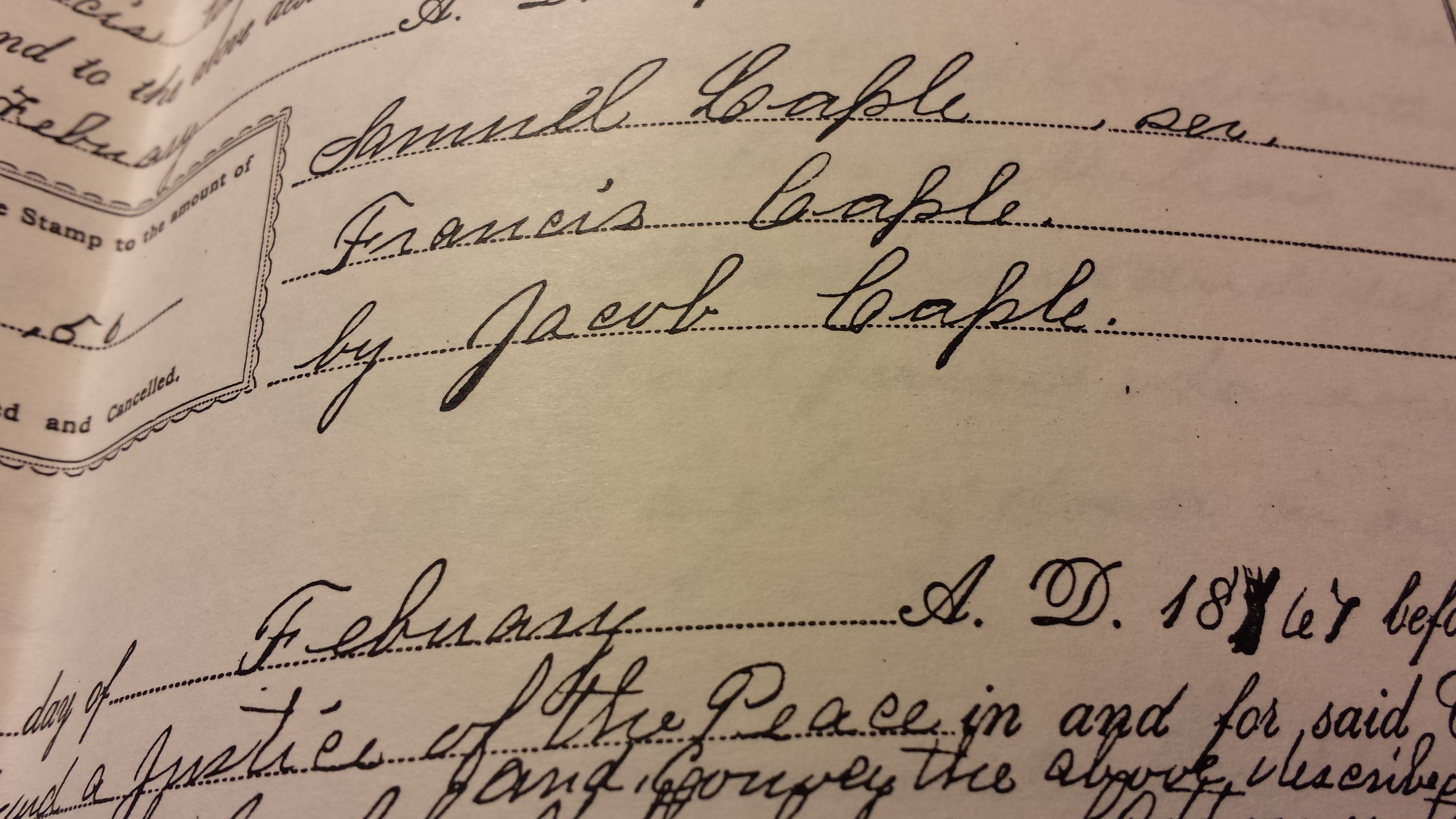
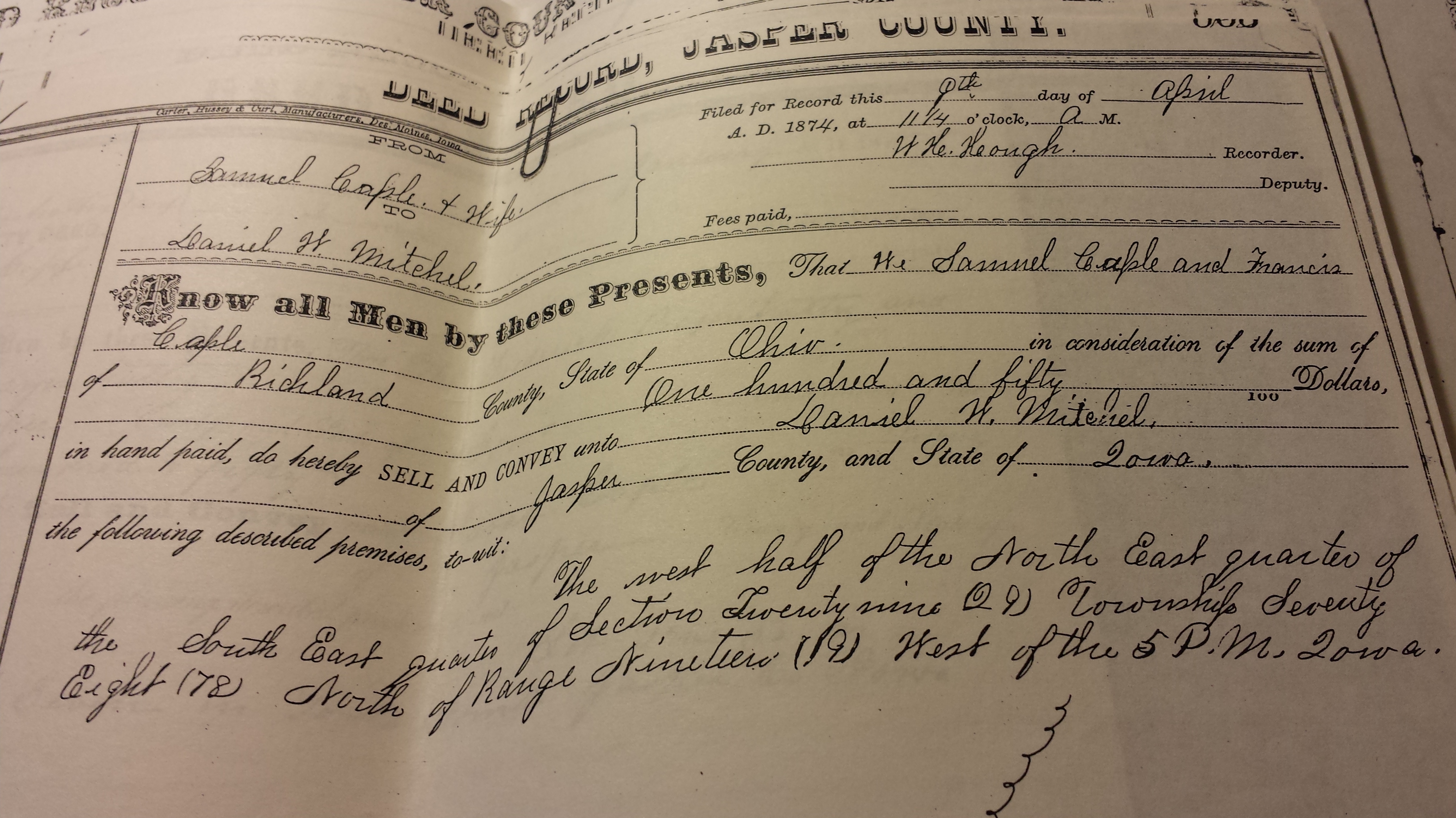
At the court house she found deeds for Nimrod plus some for a Samuel Caple with Jacob Caple having  power of attorney to sell the property. We assumed the Samuel was his son Samuel Hugh Caple.  At the end of my visit she lent me the deeds to make copies.2015-05-12 19.17.42

That evening I  sat at  my kitchen table and re-examined the documents. The first deed was for property sold in 1863, the others were for 1867.  Both my aunt and I had assumed Jacob was selling land for his son while he was serving in the Iowa infantry in the civil war. But Samuel was only 18. Would someone so young have property to sell?  And why didn’t he take care of it himself in 1867? Then I noticed something else. The deeds said Samuel lived in in Richland county, Ohio not Jasper county, Iowa. And the wife was named Francis not Polly. And besides Samuel hadn’t married until 1868. The place, names and dates didn’t add up, this Samuel had to be someone else, but who and how were we connected to him?

2015-05-12 19.13.49