Tag Archives: genealogy

Militiary and Pension File For Samuel Hugh Caple Examined

2015-04-11 22.13.29

I loved hearing my Grandpa Caple reminisce about traveling the Oregon trail when he was a boy. He also told  stories of his dad’s civil war experiences especially his survival of Andersonville Prison. He said his Dad had enlisted at age 16 at the outbreak of the war. Since he was underage his father had fetched him home. When he turned 18 the war was still going and he enlisted again.  Apparently, he soon had second thoughts but this time he had to stay.

He told me his dad was wanderer always thinking the grass was greener somewhere else, never staying in one place long until his wife put her foot down and refused to move again.  Stories of how his Dad had worked with the likes of  Buffalo Bill Cody and Wyatt Earp in Dodge city fascinated me.  He told me we’d be rich if his dad hadn’t somehow lost his claim on most of what is downtown Spokane.

But when I asked where the Caple’s had come from; the only thing he recalled his dad saying was they had come from the south. Once slave owners they had sold the plantation moved north after deciding slavery was wrong.

Now I had his father’s, Samuel Hugh Caple’s, service records along with his and his wife’s pension files.  What would they tell me?

First there was a description of Samuel. At  5 ft. 7 inches he wasn’t a tall man but I bet his dark hair, fair complexion and blue eyes turned a few heads on the girls when he was a young.

He had served as a private in the Iowa 5th volunteer Infantry, Company B and later in the Iowa 5th Cavalry.  He had enlisted for 3 years on 11 Sept. 1863 in Vicksburgh Mississippi receiving a 100 dollar bounty for enlisting.

His unit had taken part in the Battle of Mission Ridge on Nov 24th and 25th of 1863.  They had been furloughed to Davenport, Iowa from April 8th to May 7th 1864.

On Augut 8, 1864 he was transferred to Co. I, Iowa 5th Calvary at Long Pond, Georgia (the reason was the 5th infantry and 5th Calvary had suffered huge losses and thus were combined into the 5th Calvary.)

He was absent on detached service for Dec. of 1864 and January 1865 working as a teamster since 12/64 which meant he was most likely involved in carrying supplies for the troops.

He was mustered out of service on Aug. 11, 1865 in Nashville, TN.
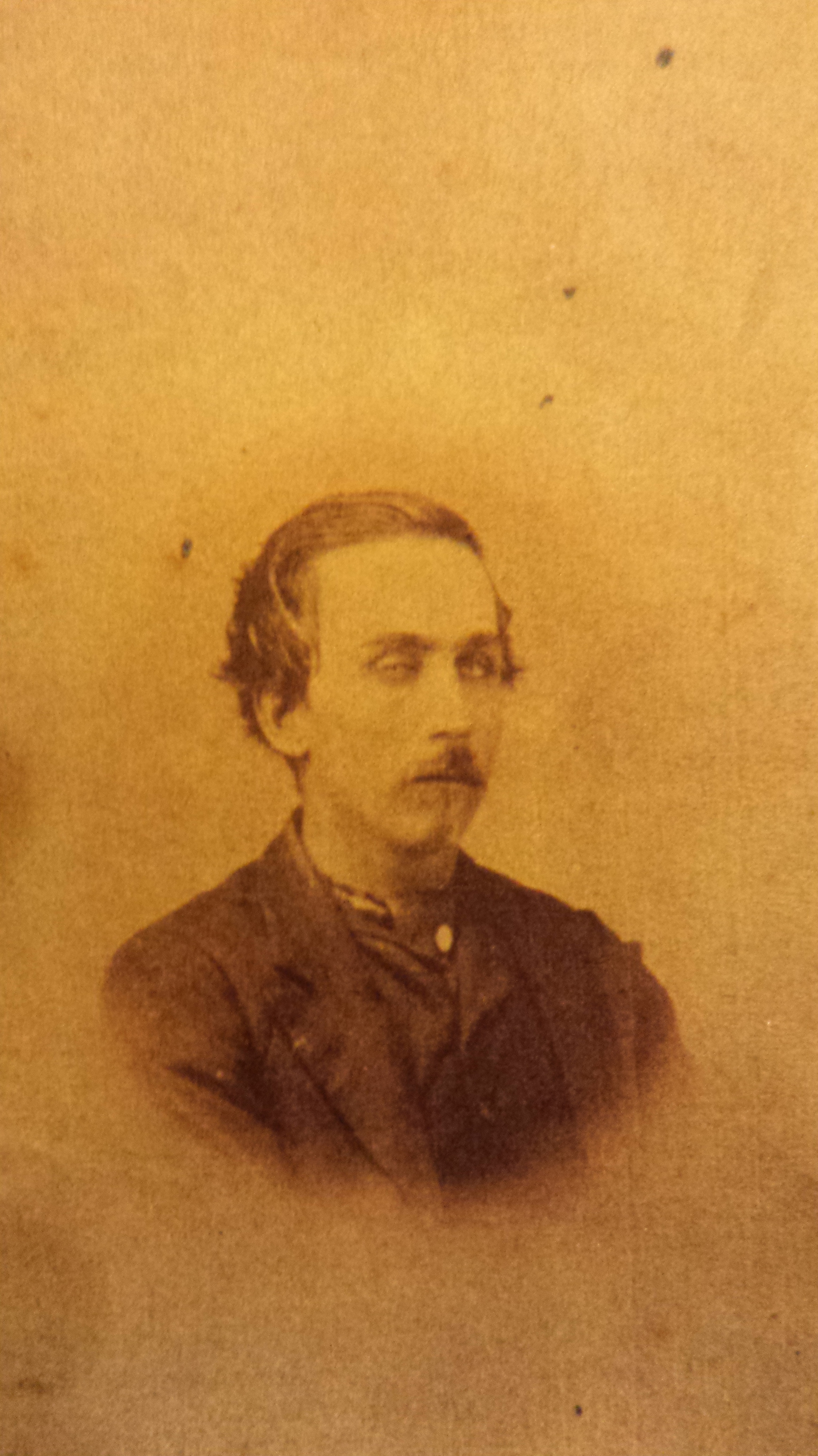
2015-04-11 22.12.48I was told this photo of Samuel Hugh was taken right after the end of the Civil War. Supposedly he had a husky build when he enlisted but as a result of his imprisonment had returned home a much smaller person.

He had  applied for pension three times. His wife Margaret applied for a widow’s pension after is death.

He was born in  Mt. Vernon, Ohio on March 28, 1845 to Jacob Caple and Sarah Ann Garey. At the time of enlistment he had been living in Monroe, Iowa and lived there afterwards until 1876. He had also lived in Dodge City, Kansas, Puyallup, WA and Oklahoma.

2015-04-11 22.11.52

His first  application for a pension was made in March of 1894.  At that time he was living in Caple, Oklahoma. He stated that he was unable to support himself by reason of rheumatism and piles and also heart, spleen and liver complaints.  He wrote that he had first aquired spleen and liver complaints March of 1865 in Selma, Alabama, due to exposure.  The rheumatism had started in 1873 and he had been troubled by piles or 16 years. This application was witnessed by a W. M. Edwards and Richard B. Quinn. In another document both of these parties swore that they had known Samuel for 25 and 1/3 years as of March 1894.

There was a doctor’s avadavidit stating that he suffered from Rhuematism, Hemorroids and chronic endocarditis and enlarged spleen from June of 1895.

This application for pension was denied.  In 1898 he again applied.  In this application he stated that he had married Margaret (Maggie Ragsdale) in Brookline, MO, on Sept. 16, 1877 and had previously been married to Polly A. Caple who had died on June 10, 1876 in Monroe, Iowa.

He listed his living children as Milo age 23, Minnie age 30, Samuel age 19, Joe age 14, Roy age 12 and Richard age 8  ( Note: one more  child, Lida would be born in 1899). This application was also denied but when reapplied in 1912 it was accepted.

In Dec. of 1920 his widow Margaret applied for a widowers pension.  Among the papers in this application was a copy of his death certificate. His address was given as 510 16th st. S. E. in Puyallup, WA. His date of birth was verified as being March 28th 1845.   He was age 75 years, 8 months and 8 days. It confirmed his place of birth as Mt. Vernon, Ohio and his parents were listed as Joseph Caple b. in Maryland and his mother as Sarah Gery also born in Maryland.  The informant for this information was listed as his wife Margaret M. Caple.
He died on  Dec. 6th 1920 at 10 a. m. The cause of death was diabetic gangrene of
the foot and he was buried in the Orting Cemetery, Dec. 8 1820. Margaret also
gave their marriage date and place of marriage as previously stated.  She had had
been born, March 31st. 1858  near Brookline, Green County, Missouri.  Her
pension request was accepted.
 Now that I knew more about Samuel Hugh Caple  my appetite to know more was
whetted. He’s said his parents had been born in Maryland.  Was Maryland
considered a southern state? A quick look up told me it was. Had this been the
state of the old family plantation?  Had there ever been one? Or was the story of
moving north because of opposition to slavery just  been told to make the family
sound good.
 And who exactly were his parents? Why had they moved from Ohio to Iowa?
To answer these questions I would need help. The first two thing I did was buy a
book on researching your ancestry, next I talked to my Dad. He didn’t remember
much more. He suggested I call my Aunt Iva he was pretty sure she could tell me
more. I scheduled a time to meet with her as soon as I could spare time to travel
to Bremerton for a day. In the meantime I decided to see what resources my local
library held. While there I made two discoveries. Their collection included a book a
Caple family of Maryland.  Were these my ancestors? And I had found a Samuel
Caple who had served in the Revolutionary war. Surely I would have heard about
such an ancestor.  But he was named Samuel, could he be an ancestor?
To answer these questions I had a lot of work to do.  First I had to start with what
I did know and work my way backwards.  Time to do more research on my great
grandfather, Samuel Hugh Caple and his father Jacob.


Finding Caple Oklahoma Or How I Got Bit By The Genealogy Bug

2015-03-30 19.51.53

I pulled the thick packet out of the mailbox – return address National Archives, Washington  D.C.  The Civil War military and pension records for my  great  grandfather, Samuel Hugh Caple, had arrived. I crossed my fingers  and opened it hoping the information my Dad wanted was within.

Growing up both my Dad and I had listened to stories about how his grandfather, Samuel Hugh Caple, had survived being a prisoner in the notorious southerns Civil War prison – Andersonville.  My Dad had even spent a day spent a day touring the former prison site.  There he learned if he could show documentation of Samuel’s being a prisoner his name would be added to the the list  of survivors.

Unfortunately the papers from the National Archives did not have the record he desired but it did contain other valuable family information.

Other than the civil war stories I never heard tales about my Caple ancestors, except one.  My grandfather said the family had once been plantation owners somewhere in the south and had moved north because they didn’t believe in slavery. He didn’t know which state nor had any idea what country they may have come from from originally.  Someone said the name sounded German so he thought maybe they had come from Germany.

Among the many papers in the packet were affidavits from several people who said they had known Samuel while living in Caple, Oklahoma.

I recalled my grandfather mentioning he had lived in Oklahoma for a time while a boy.  But he had also said his father was a wanderer and they never lived anywhere long. So where exactly was Caple, Oklahoma?  How come I had never heard of it?  If my great grandfather had lived there, once upon a time, was this the southern state  the family had come from? Wy was it called Caple?  Outside of my family I had never even met another Caple.

  I set out to find the answer. I told myself I’d just find out where Caple was and how it got it’s name. I had no intention of doing more.

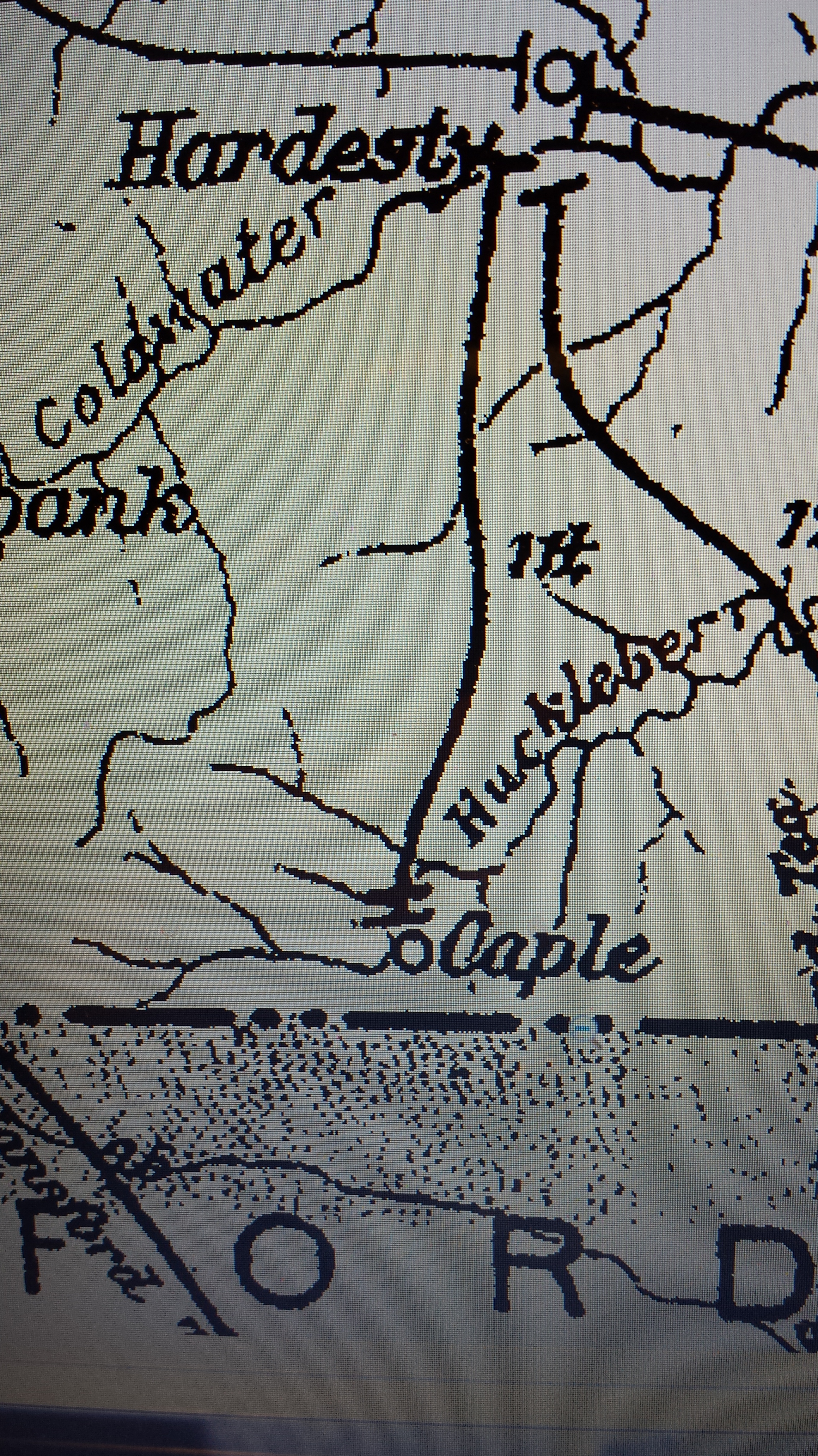
The archive’s papers showed Caple as being in Beaver county, Oklahoma.  I looked for it in a current atlas.  It wasn’t there but an 1899 Atlas, I had purchased at a yard sale, did  have a Caple,  Oklahoma.  It was in the southern portion off Beaver county (now Texas county), south of Hardesty, near the Texas border.

But I still didn’t know why it was named Caple?  And what had happened to it?

Today a search on the internet would give me the answer but in 1993 other avenues had to be pursued. I needed to learn how to trace my family history and thus began my affliction with the genealogy bug.  


Treasure Chest Thursday

Rustic Vase from My Grandma Rose

Rustic crockery vase belonging to my Grandma Rose Uelmen Meyer

Treasure chest Thursday means it’s time to share a family gem.  Yes, the sunflowers are pretty but the crock is the focus of this piece. Mom gave this to me several years before she and my Dad moved out of their house.  She knew I’d appreciate it’s rustic charm.  It’s my favorite vase for country bouquets.

I find it kind of strange though, that my Mom  chose this as one of the few things she could take from the family farm. Living in WA state limited how much she could bring home and she didn’t really care for the rustic look.

Although you can’t see it in this photo the crock does have a chip along it’s rim. It was the sort of thing she’d say when shown, “Who’d want that old thing.”  This piece must have must have spoken something about her childhood home and mother though, I guess I should have questioned her more.

She did tell me that her Mother found this piece while poking around in a vacant lot across the road from the church they attended. (ST. Mathias Catholic Church, Auburn Township, Fond Du Lac county, Wi)  According to her a  German convent had once sat on the property.  She figured the crock was something they used.  She told me the convent had been long gone by the time she was born.

So my question to you is – what kind of family treasures do you keep? Feel free to share in the comment section.

Throw Back Thursday

This photo is in honor of my Dad and Father’s day this coming Sunday. I’m planning to spend the day with him so this is a little early.   Happy Father’s Day, Dad!

I actually have the sailor suit he is wearing. His mother made it.  I think he must have been 3-4 years old so the year must be  about 1925 or 26.   He’s holding a bunny so maybe it’s an Easter photo.

The photo was taken at his home in Puyallup, WA.  The stonework behind him was part of the porch his dad built.  The house and porch are still standing nearly 100 years later.  He carried the stones home from the Carbon River.

John Meyer Gets Married

John Meyer and others at is home in Cascade

John Meyer and others at is home in Cascade. PD_0050


When Johannes’ and Julia Meyer went back to New York state they  took their youngest son Charles back with them. Johannes’ daughter, Catherine (known as Kate) was still in New York.  The remaining 5 Meyer children remained in Wisconsin. Margaret married Phillip Welter and eventually ended up on a farm in Kaukauna, WI.  Anna had married Fredrick Seyforth ( Julia’s son) and moved to a farm in the area of Pepin, Wisconsin. Mary married Wilhelm Demand, a civil )war veteran.  They lived in Sheboygan, WI. The two boys John and George were still unmarried when their father left but also remained in Wisconsin.  George married Sophia Allman and eventually moved to Brown county, South Dakota.  And John, my great grandfather settled in Cascade, Wisconsin where he became a shoemaker.

The 1880 census shows him boarding with August Hafenmeister, also a shoemaker and his wife. In the same census a young woman  by the name of Maria (Mary) Thomsen is living and working as a servant in the town.  The following year these two would marry on July 10th, 1881.

Mary was quite a bit younger than John. She had been born in 1860 in Denmark.  Thus making her almost 16 years younger than he.

They settled into a house in Cascade and soon their first son was born.  They  named him William.  He died about a year later of summer complaint.  He was followed by three more sons, Frank born in in 1884, Geroge H. in 1888 and Arno A. in 1893.

In 1892 John and August Hafenmeister dissolved their partnership and John continued to run the shoe business until 1925 on his own.

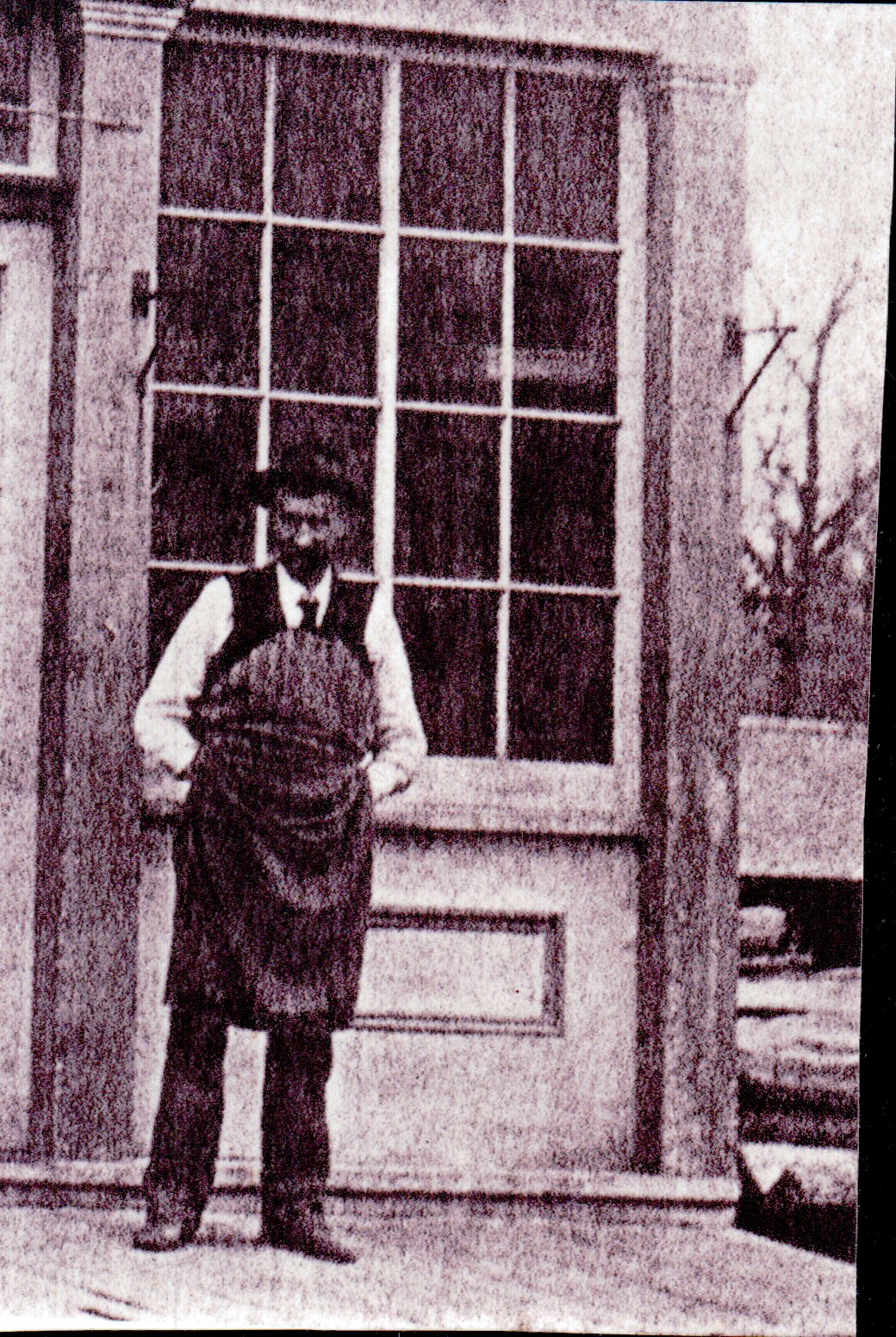
The picture below is a photo taken of John Meyer in front of his shoe shop.PD_0067

I know very little about their life there in Cascade except through frequent mentions in the Sheboygan Press after 1914 until his death in 1926.  His shoe shops was reported as a popular meeting place for the villagers to congregate to share the happenings and news of the day so he must have been a friendly, outgoing kind of man.

In January 1915 the Shebogan Press reported that John Meyer had remodeled and repainted his store and added electric lighting an improvement the paper suggested others in the village should also do.

The frequent postings in the Sheboygan Press similar to the ones below tell us friends and family were an important part of their life.

Feb 19, 1915

“Mr. and Mrs. John Meyer are entertaining Arno Meyer of Madison and George Meyer of Ladysmith and Miss Rose Allman of Dundee.”  (This post is  tells us John and Mary had their sons over along with George’s fiancé Rose Uelmen.  It also tells us George must have moved to Ladysmith before his marriage and that perhaps Rose is teaching school in Dundee.)

March 11, 1915 reported that; “Mrs. Koch and daughter Marion left for their home in Sheboygan on Monday after spending several weeks with their rleatives Mr. and Mrs. John Meyer.”  (Mrs. Koch would have been John’s niece and daughter of his sister Mary Meyer Demand. Although it is only 11 miles between Cascade and Sheboygan the frequency of family members  remaining several days on visits suggest getting to and from the two places was time consuming in the late teens).

In February of 1916 the paper reported: “John Meyer has returned home after he spent several days with his son George in Jersey.” ( This would have been just after George took over the farm there.  His Dad was probably helping him get situated. Rose had given birth to their first son John on Dec. 13th while the couple were visiting George’s parents in Cascade. According to my mother, Jeanette Meyer Caple, he was premature and very small. His grandmother Mary Meyer,  put him in a shoebox and kept him warm by the stove. Mary’s good care during the first few weeks of his life was credited with keeping him alive.)

June 30, 1916 the paper reported: Mr. and Mrs. George Balhorn, Dr. and Mrs. A W. Kraelzoch, Mr. and Mrs. Selle and Mrs. Thomson of Milwaukee, Mrs. Koch and daughter Marion and Mr. and Mrs George Meyer were week-end guests of Mr. and Mrs. John Meyer. (Mrs. Koch was John’s niece and Mrs. Thomsen was probably the wife of Mary’s brother Tom.)

On October 20, 1916 the paper reported: “Mr and Mrs. John Meyer motored to Jersey and were guests of Mr. and Mr.s George Meyer. (This post also indicates they own a car.)

Still other posts tell of John and Mary going to spend time with the same people in their homes.

In 1925 their are several posts mentioning that their grandchildren: John, Gertrude, Margaret and Marilyn have spent time visting their grandparents over night indicating that the couple enjoyed having their grandchildren around.

On Dec 8th, 1926 the paper reported that Mr. and Mrs. George Meyer and children visited on Sunday at the John Meyer home. Also that Mr. Arno Meyer of Waldo spent Monday at the John Meyer home. These 2 visits were most likely precipitated by a stroke John had suffered at about that time. A week later on Dec 13th he died at the age of 81. His obituary reported he had been in the shoe business for more 60 years and had enjoyed good health up until the stroke that resulted in his death. His funeral was held at the Cascade Lutheran Church and he was buried in St. Paul’s Lutheran cemetery, in Cascade.


Life in New York

When we last left off, Johannes and his family were standing on the docks of New York City. Whether they had purchased the land for their new home while still in France or after their arrival in New York is unknown. However,we do know French land agents worked hard enticing Alsaceian families to settle in Lewis county, New York.

According to Johannes’ grandson Pierre, they had either settled first in Belford, which would have been in New Jersey or more likely Belfort, Lewis county, New York. Since it was already fall the family must have had enough additional money to buy most of the provisions they would need to survive until the next year.

They built a log home on the property which was what most families in the area had. In the spring of the following year Marguerite,Johannes’ wife, died.The cause of her death is unknown. She was buried in a clearing near the log home.

Did the lost of his wife make Johannes ponder the wisdom of moving his family? Did a hard winter and a lack of enough resources contribute to her death or had some epidemic rage through the community? We will never know but Johannes was now left with 6 mother-less children ranging in ages 2-12 and a farm with poor soil.

He moved his family to Naumburg, another small village in the area, in 1851 or 1852. There he married Julia Schlieder Seyfarth, the widow of Frederick Seyfarth. She owned the farm adjoining his new property.

In the fall of 1953 Johannes began building a very fine home. According to his grandson Pierre it was larger and bigger than most of the homes of the time. Travelers often mistook it for a tavern. Today a large farmhouse exists on this same property. Further research needs to be done to determine if this is the same house.

The new farm was in Croghan, Lewis County, NY and is described as being lot 5 of Mocombs Purchase. From a Croghan pamphlet dated 1858 we know there were 500 European families in this area most from E. France or adjacent Germany. In 1848 the population of 1,168 were broken down to 646 American and 522 as French.

In 1854 Johannes and Julia had a son they named Charles Julius. Later that same year Julia’s daughter Wilehmina married Ferdinand Sonatag.

In the 1855 census New York census Johannes is listed as John Mairars age 37. His framed house is marked with a value of 600$ considerably more than the log homes of the rest of the area. He has 40 improved acres and 110 unimproved acres. The total value of the farm is given as $2,200. He has another $190 in stock and $50 in tools.

Crops were listed as wheat, oats, potatoes and hay. He owned one head of cattle, 2 butter cows, 2 sheep, 2 swine and one working ox.

In 1856 another son Augustus Lewis was born. At the age of 6 months Johannes and Julia allowed Augustus to be adopted by Julia’s daughter Theresa. The family story was that she and her husband Fredrick Hoffman were unable to have children.

In Feb. 0f 1862 Julia’s son Fredrick married Johann’s daughter Anna.

In May of 1863 Johannes and Julia sold their land in New York and moved with their unmarried children to Wisconsin where they settled near Lima township, Sheboygan county. Their now married children – Anna Meyer and Fredrick Seyforth – either went with them or came the same year.

Their new property was near what is now Kohler state park. It would need to be researched more but it is possible part of his land is now within the park boundaries.

In 1865 Johannes’ daughter Margaret married Phillip Welter in Sheboygan Falls, later the same year his daughter Catherine, married Fredrick Sauer in Lewis County, New York. In 1866 his daughter Maria Meyer married Wilhelm Demand in Sheboygan, Wi.

It is not known why but sometime before 1870 Johannes and Julia decided to move back to New York. This time to a small farm in Wayne county.

In 1870 the couple decided to separate and split their assets with Johann moving back to Alsace to live with a brother while Julia took their son Charles to Watertown, NY to live.

When Johannes got back to Alsace, he only stayed 2 days before war broke out. He returned to the U. S. living for times with each of his married children until 1872 when the war ended. Johannes then returned to Alsace to live the rest of his years with his brother.

He died around 1906. A document found in Sheboygan shows that one of his daughters was appointed to see to the dispersal of his small estate. The lawyer handling his affairs in Alsace was from Neiderhausbergen (a small town near Strassburg) indicating that was where he was living at his death.

We have now documented 8 children and 35 grandchildren for Johannes Meyer.

Ring, Ring, New York Calling

About a week after sending my letter to Harry Bingle the phone rang.  A  Betty from Carthage, NY  called.  When she informed me the Harry Bingle in the nursing home wasn’t the one I wanted, my heart plummeted. She told me the Harry I wanted had died in 1968. Then she told me the Harry I was looking for was her father and Catherine Sauer Meyer her great-grandmother. She went on to say it was just by luck the letter had reached her. Someone on staff knew her and had recognized I was inquiring about her family and had passed the letter on.  Talk about serendipity.

She went on to tell me several of Johann Meyer’s descendants still lived in the area. Her family had kept in contact with the far flung offspring who’d left for Wisconsin but eventually had lost track of them. She was able to verify, the names I had for the girls, were correct. She promised to send me her Great- grandmother’s obituary which said the family had been from Strasburg, Alsace.  And she offered to do more digging in the records in her area when she had time.

Not long afterwards a Mr. Seyforth from Milwaukee Wisconsin e-mailed me.  He’d seen my query on Johann Meyer and thought we were looking at the same family. Several quick e-mails back and forth determined that we were indeed were and we each had information to share.

When I had begun my Meyer search both my Mother and Aunt Gert had mentioned that their parents occasionally made trips to Mondovi, Wisconsin to visit relatives. They weren’t sure who they were or which side of the family they belonged to.  When my new contact mentioned his Seyforth family had farmed near Mondovi I knew they must be the relatives my grandparents had visited. My mother had also mentioned a Jessie Koch and a Trilling from Sheboygan as Meyer relatives who came to their family gatherings. How they were related she didn’t know.

Soon I got a packet of printed material my Seyforth contact.  Someone in his family had compiled the family names birthdates at an earlier time and he included that along with his research. The papers gave the place of origin for the family as Alpheshiem,  Niederetses, France and listed the name of Johann’s first wife as unknown.  (Niederetses, I would later learn meant Alsace) Then it listed his children as:

Margaret  who had married a Phillip Welter and they had lived in Pepin county, Wisconsin.

Anna had married Fredrick Seyforth and lived in Mondovi, Wi.  He was also her step-brother and son of Julia, Johann’s second wife.  (No wonder my grandpa George had trouble keeping this family straight.  He had an uncle who was being raised by one of her daughters and an aunt who had married her son.)

Catherine (Kate)  had married in New York to Fred Sauer.

John,  who had married Mary Thomsen and lived in Cascade, Wi

Mary married a William Demand and lived in Sheboygan.  She had descendants by the name of Jessie Koch and a Hattie Trilling the names my mother had mentioned.

George  married a Sophie Allman and they’d gone to live in Aberdeen South Dakota around 1900.

Also included in the packet was a copy of this photograph taken in Plymouth, Wisconsin.

Image

Meyer siblings. L-R Mary, Margaret, John and George taken about 1900

Johann Meyer married second, Julia Schleider Seyforth  Her children were:

Theresa who married Mr. Hoffman. ( The family said she was unable to have children and so adopted her half brother Johnann and Julia’s youngest son Augustus and lived in Wayne County, New York.)

Wilamina married a Mr. Sontag and lived in Clifton Springs, New York.

Fredrick married Johann’s daughter Anna Meyer.

Together Johann Meyer and Julia had children:

Charles  Meyer who live in Carthage, New York (father of Pierre and Edith)

Augustus Meyer Hoffman ( child adopted by half sister)  Family stories said his half -sister had been unable to have children so Julia and Johann had allowed her to adopt their youngest child.)

I now had two separate branches of the family to collaborate with.  Together we were able to fill out much of the family tree and account for not only the children of Johann but their children as well.  But there was still some details that eluded me including where in Alsace thy had come from?  Without a village name it would be next to impossible to trace the family back any further. Our collaboration had suggested several names: Strasburg from some of the girls obituaries, Airsheim from John’s marriage certificate and the Aphesheim suggested on the Seyforth document. With the exception of Strasburg I’ve been told the other places had never existed. It was suggested that perhaps the places had been eaten up as the city of Strasburg grew.  I also  needed to know the name of where Johann had died.  Who was the brother he went back to live with?  And of course I wanted what every genealogist wants to know, who were the parents?

For the next several years I added very little to my Meyer research until another descendant of the Meyer family contacted me. But that is another story to be shared another day.