Category Archives: Uncategorized

IN SEARCH OF JACOB CAPLE’S Father

2016-02-22 20.41.47 (2)

Jacob Caple, born about 1816, Carroll County, Maryland

Synopsis:  Through family stories and my Great Grandfather, Samuel Hugh Caple’s Civil War pension records, I had discovered Samuel H. Caple was born in 1845 in Knox County, Ohio. His parents were Jacob Caple and Sarah Garey.  Jacob had been born in Maryland but married in Knox county, Ohio in 1841. Around 1857 Jacob had moved his family to Monroe, Jasper county, Iowa. Land documents there, led me to believe, he was connected to Samuel Caple of Richland County, Ohio. Census records in Ohio revealed that a Samuel Caple had lived there and had also been born in Maryland. He was the right age to be Jacob’s father.  Now I needed a will or other document to prove a connection


IN SEARCH FOR JACOB CAPLE’S FATHER

Shortly after mailing my request for a will for Samuel Caple of Ohio, my husband and I visited a used bookstore. As I gazed at a shelf of fiction, my husband rounded the corner.

“I found something for you to look at.” he said.

He handed me a thick book of  genealogical queries. He pointed to an entry –  “CAPLE, SAMUEL.”  A Daisy Lee Grimes was looking for more information about her great-grandfather, Samuel Caple, born in Maryland and who had lived in Ohio. I was fairly certain this was the same Samuel Caple I was looking for.  I would have called her right then and there except the book was from the 1940’s, it was unlikely that now in the 1990’s, Daisy was still alive.

The following week I perused the shelf containing family genealogies at my local library. I knew there was no way I was going to find a Caple genealogy, still I looked. My eyes scanned the titles for surnames beginning with C – “History And Genealogy Of The Caples Family And Allied Families Of Maryland.” Surprised, I pulled the book off the shelf.  Could this be my family, Jacob was from Maryland.

I opened the thin, hand bound book. It had been written in the 1960’s. The Caple’s in this book were from the earliest days of colonial Maryland. I still had a lot of work to do before I could discover if we connected to this family. But how had this hand typed copy from Maryland ended up in a Tacoma, WA library?

The following week I went to the Seattle National Regional Archives to work on another branch of my family tree. I was re-winding a microfilm when the archives announced it would be closed in 30 minutes. I gathered my things and went to slip the film back into its place in a file cabinet. Bent over, I glanced sideways, the words – CAPLE, SAMUEL – jumped out at me.  It was the first entry for a drawer full of Revolutionary War pension files.  Why was I suddenly finding the name Caple everywhere?

Never mind the archive was about to close, I had to see what was on it. I hastily threaded the microfilm onto the machine. I scrolled forward, the file was long. Quickly I skimmed, the old, difficult to read, cursive writing. Fortunately the pages deemed to be the best source of genealogical facts had been placed at the beginning of the file. This Samuel Caple had been born in Maryland. He hadn’t mentioned children by name but did say he had sons. And since he was born in 1752, he could easily be Samuel Caple of Ohio’s father. But it was too soon to jump to such conclusions.  I left hoping someday I would have reason to return and inspect this film in detail, in the meantime I had to prove or disprove Jacob was the son of Samuel Caple in Ohio. Only then could I begin to look for a link for someone in Maryland. Now more than ever I was anxious to find Jacob’s father.

On a rainy day a few weeks later, I pulled a thin envelope postmarked Ohio out of my mailbox. It looked much too thin to contain the information I wanted. With shaking hands I ripped the envelope open and pulled out the  will for Samuel Caple of Richland County, Ohio.  I began to read the difficult to decipher writing ; fingers crossed it would contain Jacob’s name.

Who was Samuel?

It’s been a while since I wrote about the discoveries I made with my Caple family history, so I am including a brief synopsis of what I have written thus far before moving onto the next chapter.

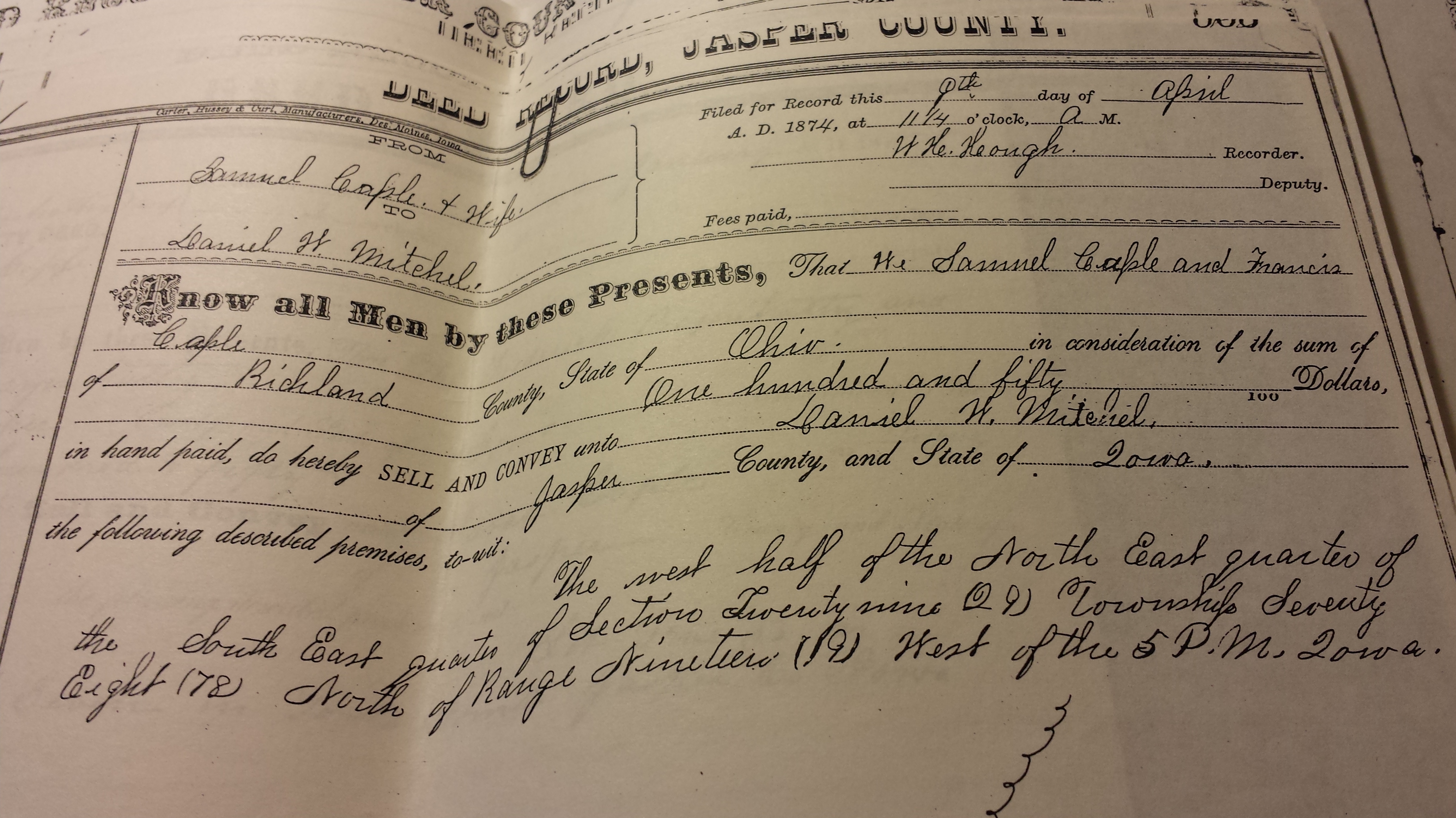
According to my Grandfather, his father Samuel Hugh Caple and had fought in the Civil War. From Samuel’s Civil War pension papers I learned he had been born in Ohio, his parents were Jacob and Sarah Geary Caple.  While in Monroe my aunt had copied some deed we assumed were for Samuel Hugh Caple. But on closer inspection I noticed the the facts didn’t jibe.  The deeds seemed to be for different Samuel, one who lived in Richland county, Ohio.

—————————————————————————————————————————–Family known so far: Grandfather-William Roy Caple b. 1885 -1971, Great Grandfather- Samuel Hugh Caple 1845-1920, GG Grandfather Jacob Caple 1816- after 1872?  2015-05-12 19.13.49

WHO WAS THIS SAMUEL CAPLE?

After discovering the possibilty another Samuel Caple might be connected to the family I paid a visit to the local “Family History Library” run by the LDS church. There I was met by a friendly volunteer who suggested I start my search with the IGI index.

I typed in Samuel Hugh Caple. Up popped his name along with his parent’s Jacob and Sarah Garey Caple, his first wife Polly Sumpter and their children Milo and Minnie. Information I already had.

Next the volunteer guided me to look in the 1860 census for a Jacob Caple in Iowa. Armed with a page number from the census index book, I soon was whirling through microfilm until I came listing I wanted.

Fairview township, Jasper county, Iowa, PO Monroe, 1860

  • Jacob -age 43, born in Maryland, occupation Carriage maker
  • Sarah – age 38, keeping house, born in Pennsylavania
  • William – age 18, born in Ohio
  • Samuel- age 15, born in Ohio
  • Mary E.- age 11-born in Ohio
  • Anna Bell,- age 8 born in Ohio
  • John W.- age 6 born in  Ohio
  • Ida -age 2 born in Iowa.

With the H. added to Samuel’s name and his age I was sure I had the right family. Ida’s birth in Iowa placed the family’s move to the state to be around 1857.  So far everything matched the info my aunt and Samuel’s pension file gave. It was time to look in Ohio.

Since the children’s births indicated the family was living in Ohio in 1850 the LDS volunteer suggested I next search for Jacob in that census. It didn’t take long to find him:

Liberty township, Knox county, Ohio -1850.

  • Jacob Caple, age 34  born in Maryland, carriage maker
  • Sarah born in Pennsylvania,
  • William age 9, born in Ohio
  • Samuel H. age 6, born in Ohio
  • Mary Etta, age 1, born in Ohio.

They had to be my family. But the mystery of the Samuel Caple on the Iowa deeds still remained. If Jacob had POA, there had to be a connection.

Next I searched for a marriage record for Jacob and Sarah in the microfilm copies the library had on file. I found them but the record gave no parents names.

Next she suggested I look for a Samuel Caple in the 1850 census of Richland county. I was thrilled when I found one and he had both a wife named Francis and was old enough to be Jacob’s father.

Butler Township, Richland County, 1850 census

  • Samuel, born about 1782 in Maryland, age 68
  • wife Francis, age 32
  • Samuel, age 15 b. in Ohio
  • James, age 6, b. in Ohio
  • William, age 3 b. in Ohio

There was that name Samuel again. Now I had three of them. I recalled my grandfather saying his Dad always insisted he was Samuel Hugh Caple not just Samuel Caple. I wondered, was it because their was more than one Samuel in his family tree?

Next I checked for this Samuel of Richland county in the 1860 census.  Would he still be alive?

1860 census, Butler township, PO Shenandoah, Ohio

  • Samuel, age 77 born in MD
  • Frances age 40, born in PA
  • Samuel age 22, born in Ohio
  • James age 16.  born in Ohio.

Okay, if he  he was still alive in 1860 maybe he was still alive in 1867 , too.  He was certainly old enough to be Jacob’s parent but his wife wasn’t. Did Samuel perhaps remarry after Jacob’s mother died?

I could look for an earlier census for this Samuel Caple and in fact I did find him but before 1850 no spouse or children were listed by name. The 1840 census  would not help me prove or disprove this Samuel was Jacob’s father. For that I will need a will or some other document that might show the names of his children.

That night I composed and sent a letter to Richland county clerk’s office asking if they might have will on file for this Samuel.

In the meantime I decided to follow my aunt’s suggestion and call a cousin, also named Samuel, who lived locally. I had a lovely chat with his wife. Yes, they too,had been trying to discover the origination of the family. Unfortunately she had no new information to add. But she did have a computer.

Now this was 1993 and the internet was new. On a genealogygroup page someone from a Caple family in Maryland had contacted her. They had compared trees but found no matches. However the Maryland person mentioned a Samuel who was the son of the Revolutionary Samuel I’d found in the library book.  According to her, this Samuel had a disagreement with his brother over slavery and had moved north to Ohio.

The story seemed similar to the one my grandfather told. The one where the family had been from the south but sold the plantation and moved North over slavery. Could the Samuel on the deeds and in the Richland county, Ohio be the person my grandfather spoke of?  And if he was, could he be the same Samuel the person from Maryland spoke of?

Hopefully I would have some answers when I heard back from Richland County, Ohio. For now all I could do was wait.

Through the eyes of a B24 Navigator

2015-11-09 03.19.49

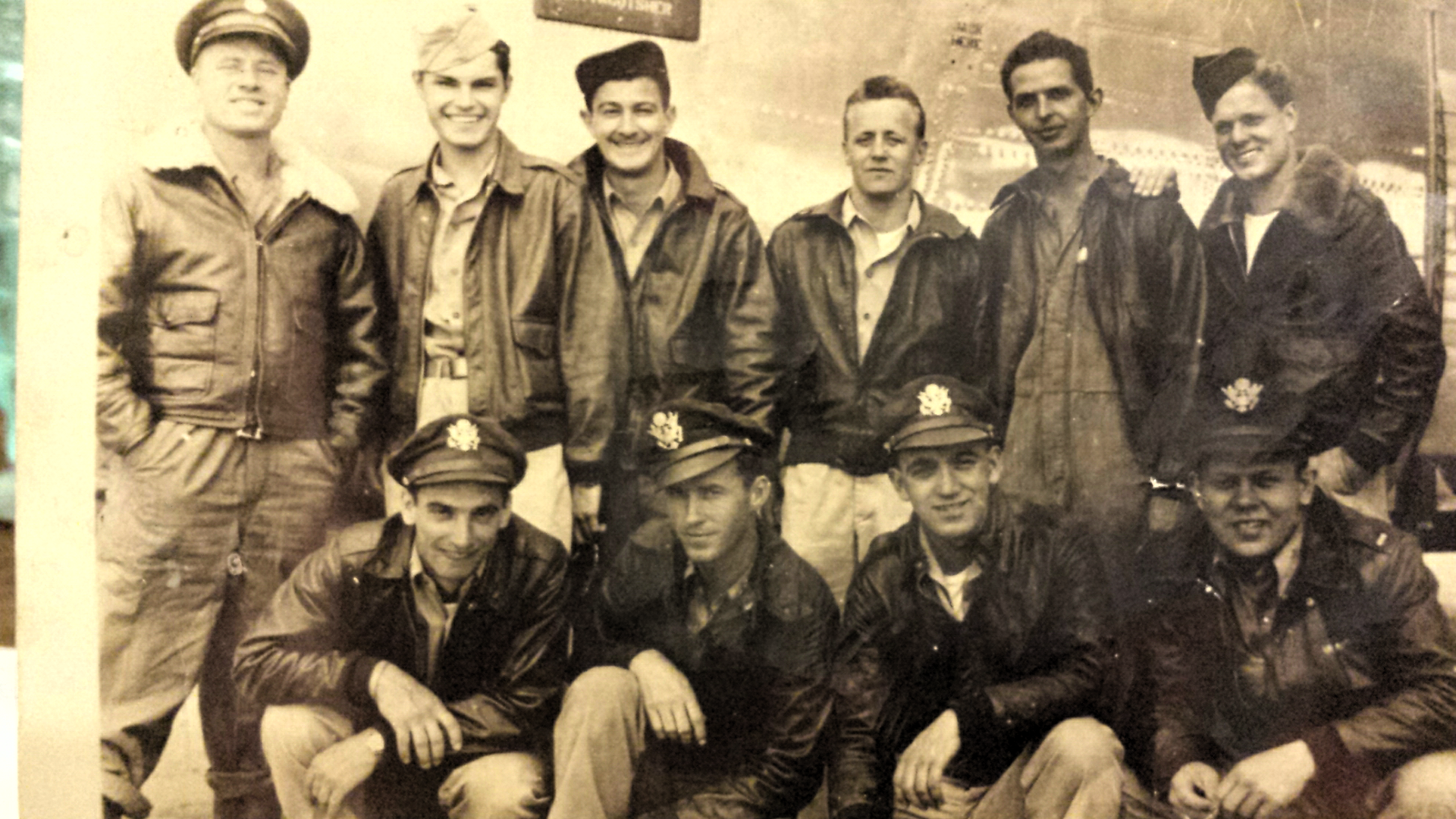
My Dad’s B 24 crew. He is in the front row, third to the right.

Around 6 years ago my Dad agreed to let me interview him about his war experiences.  When I arrived in Longview he pulled out a manila envelope. Inside were his WW II dog tags and copies of his flight logs. I’d seen them before as child when my sister and I would sometimes rifle through his battered foot locker while playing in the attic.

Like many of the baby boomer generation I grew up bored of hearing about WWII.  I had no idea what those papers, his crushed hat and other mementos represented. It was years before I got it. My dad had lived through tough times. As another Veteran’s day rolls around I wish to express my gratitude to my Dad for his sacrifice and those made by all veterans past and present.

Below is my father’s war story using his own words.

THROUGH THE EYES OF A WWII B-24 NAVIGATOR

“I still have my hat,” my Dad says, as he talks about his WWII experiences. “It looks pretty raunchy now. We were superstitious about them. They were called your lucky piece, as long as you had no problem. I wore mine most of the time I was in Italy.”

His hat must have been lucky indeed, for 66 years later he was still alive to tell me about it.

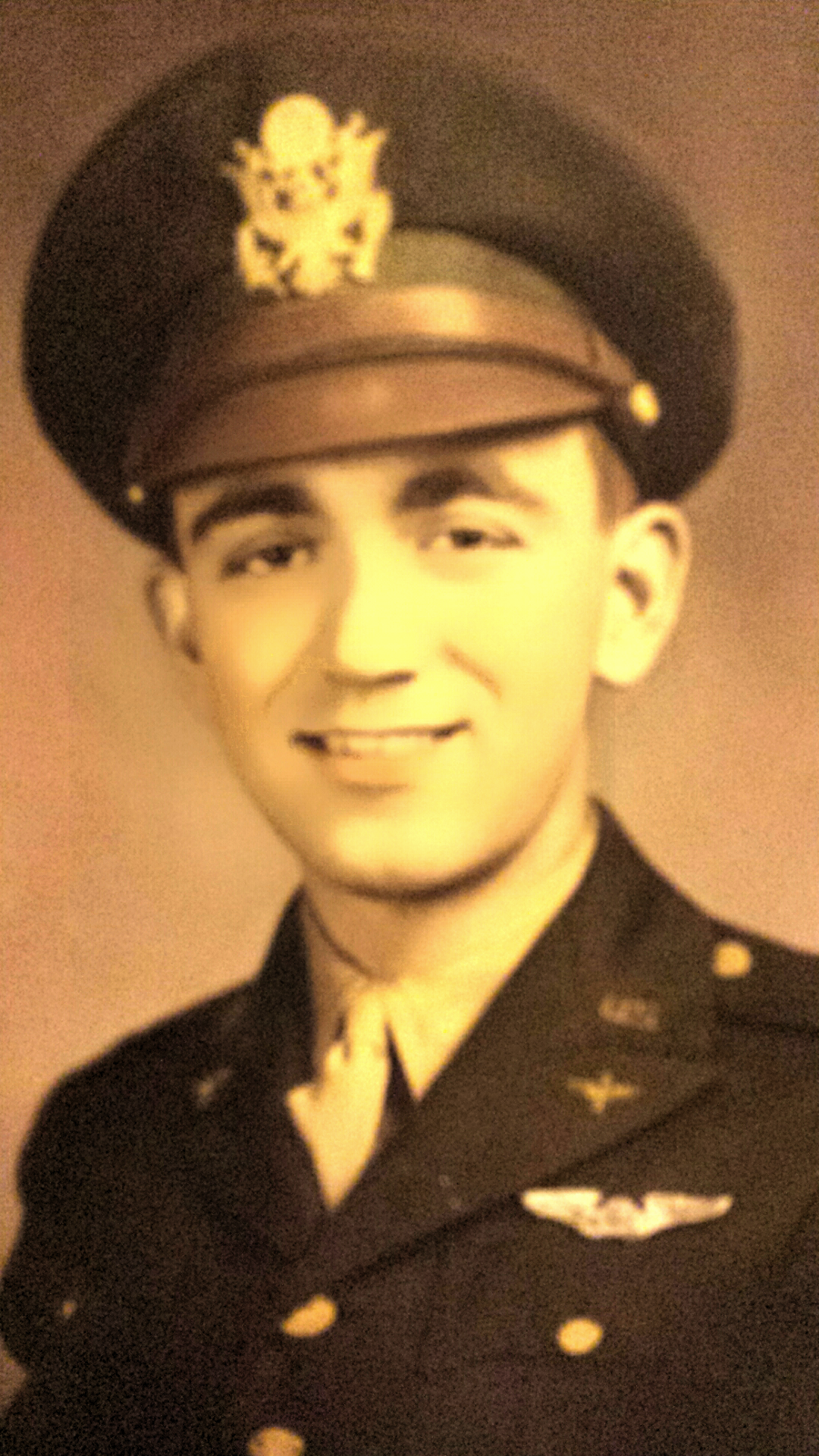
My Dad, Roger Verle Caple, grew up during up during the Great Depression. Upon graduating from High School in 1940, he had no dreams of college, he wondered if he’d even find a job. But the wheels of war were already turning. He found work at the Bremerton, Washington naval yard and by living with his sister he’d saved enough money to go to college the following September.

He was alone studying for finals on December 7, 1941, the day Pearl Harbor was bombed.

“… I decided to go to a neighborhood store to get a snack. It was there, I first heard of the bombing. The significance of the event did not sink in or how it was going to affect my future life.”

By his next birthday he was eligible for the draft. The Army Officer Aviation Cadet program offered a deferment, so he signed up.

But he said, “nobody really believed it.

By the end of winter quarter, orders to report to Fort Kerns, Utah for basic training had arrived.

His father took him to the train depot, on March 26th, 1943.

“I was surprised when my Dad, a man who showed little emotion, gave me a big hug and had tears in his eyes.”

Life at Fort KernsDad said, “consisted of, doing a lot of marching and learning what army life was like, taking tests and receiving lots of shots.”

At a cadet classification center in Santa Anna, CA.

“…. we underwent more tests for reaction time, coordination and written tests.
I was classified as a Navigator which was my first choice.”

Then it was on to pre-flight training at Ellington Field, Texas.

He was there on July 27, 1943 when a storm dubbed the “surprise hurricane of 1943,” struck. Winds, at the storms height, were clocked at 120-130 MPH.

“I noticed a particular weirdness to the air….…. Around noon we were called out to the flight line. A storm had already started. ….. Ropes were fastened to whatever points could be found and it was our job to hold the planes down. I was not about to let go of my rope I was afraid the wind would blow me away. The heavy rain was almost being blown horizontal and stung as it found any bare flesh. I had a raincoat and gloves on but when you reach up, it left an open area around the wrists. I had bruises from it. It was a steady rain. We were out there from noon until dark…..”

For a job well done he was given the week-end off. And since his father was visiting it enabled them to spend a little more time together. It would over a year before they’d be able to see each other again.

In September, he was transferred to Hondo, Texas.

There I received flight training in navigation. ……. on Dec. 24th I was classified as a navigator with the rank of second lieutenant.”

2015-11-09 03.14.31

My Dad at age 21 near the end of 1942.

Almost a year after starting basic training, he was stationed at Mitchell Field, Long Island, NY, as the navigator for a combat replacement crew headed to Europe.

“There we received a brand new plane, a B-24. It was a beautiful aircraft. We named it the “The Captain and His Kids”

On March 31, 1944 they flew it to West Palm Beach and from there embarked on their journey overseas. Their trip took thirteen days and sent them to South America, over the Atlantic and to Africa, finally arriving at San Geovani Field, Italy on April 14. They were assigned to the 455th bomb group and 743rd squadron. The base was about five miles from the city of Cerignola.

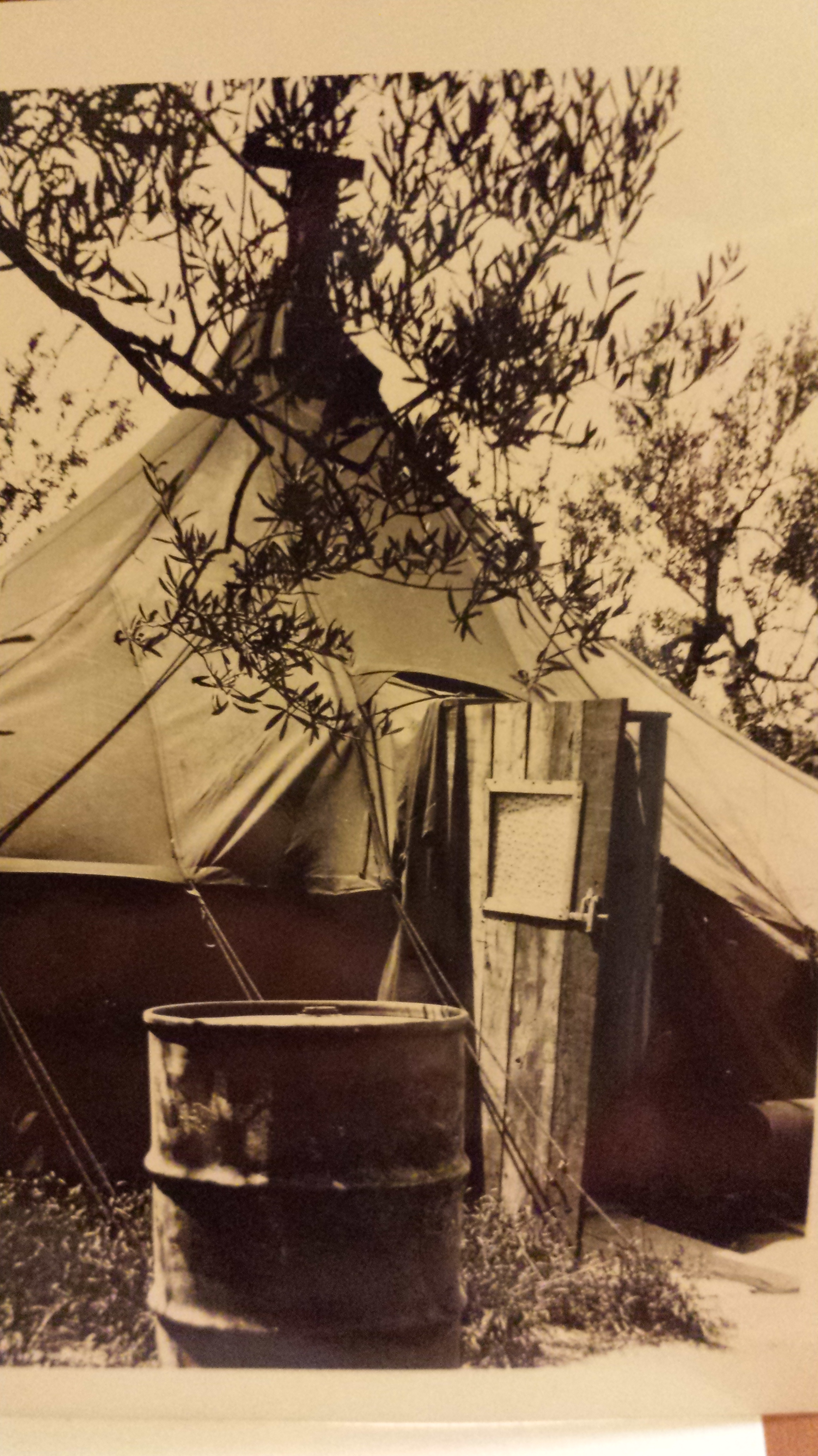
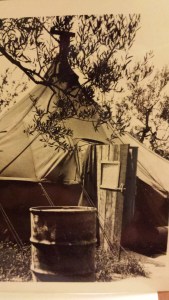
We were assigned quarters, a tent in an olive orchard. We four officers had one tent and the enlisted men had another thirty feet away. We were pleased to learn that the 743rd squadron had only lost one crew in the three months time, but not so pleased to be told that the former occupants of our tents, were that crew.“
2015-11-08 19.16.31

My Dad’s living quarters in the olive orchard.

The base had few comforts to offer. The weather was still cool.

To heat the tent a crude stove made of a 50 gallon barrel of oil cut in half was placed in the center of the tent. Gasoline was piped from a barrel outside …. We were warned that there had been quite a few tent fires….. I was glad I chose the location nearest the door for my bunk.”

“We were also warned not to expect much from the squadron mess hall. After experiencing a steady diet of powdered eggs, spam and C rations, I agree, it was not very good.”

Italians workers did the KP duties.

The help would raid the garbage cans after the meals and took home what they could to their families.”

A young Italian boy named Matt ran errands for his the crew.

He’d take our laundry to town to be done by his mother. It always came back very clean, ironed and folded neatly. We paid about a one dollar for each batch of laundry. One time I didn’t have the correct amount of money so I gave Matt a package of cigarettes which had cost me ten cents. He was very happy to get that”

“They warned us of malaria and mosquitoes. We were supposed to put nets over our bed, we didn’t though. We had pills to take. The instructions were to take every day, but they turned your skin yellow and affected the liver. I didn’t see a great risk and quit taking it.”

There wasn’t much to do there when you weren’t flying my Dad told me.

When you first go it is all kind of exciting, a new adventure, but after while it was very dreary. Sometimes we played a little softball. And I remember two or three USO shows and a few movies on base.”

“There was a lot of captured gasoline, not of high enough quality to use. People would pour it down a well and explode it for something to do. On the Fourth of July someone threw a 100 pound bomb down it…. It threw pieces of brick all over our area.”

We could go to the officers club. It was a small place to go to relax without leaving the base. Not much was available in the way of drinks and there was little ice so what had was on the warm side.”

“Sometimes the maintenance crew would place their allotment of beer aboard our plane to cool it down. It would be below freezing at the altitude we flew. They would tell us they were especially careful servicing our plane because they did not want to lose their beer.”

On non flight days, he said, they were also free to go into the nearby towns during daylight hours.

“We hitched rides on jeeps or trucks. It was easy to find a ride. I went into Cerignola quite a bit. There wasn’t much to do there; you just walked around looking for someone to talk too. There was nothing to eat there. The people were really poor. They were eager to get candy, gum and most of all cigarettes.”

“We were not supposed to go into civilian homes. MP’s patrolled the streets checking. One evening though, two of our crew and I were approached by a young boy who asked us to come to his home for a dinner. I don’t remember much, it consisted of spaghetti and a salad. It wasn’t all that great but it wasn’t bad either. There were three generations living together. One was a young man, who had been a prisoner of war, and sent to Texas. He even showed us some pictures he’d taken at the prison camp.”

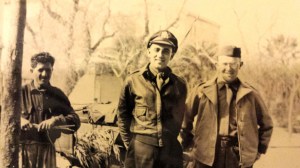
“I went to Fogia about 20 miles away. I had a high school friend stationed there. I went four or five times. And he came to see me two or three times.”
2015-11-08 19.22.40

Taken on one of his trips to Fogia.

“We got some news. We got Stars and Stripes and the Ernie Pyle stories. We didn’t have radio very much, mostly in the air, but that was primarily for communication. We did hear Axis Sally a few times up there.”

The war my Dad come to fight was in the air not on the ground. And it didn’t take long for him to be reminded he was in a combat zone. Less than twenty-four hours after their arrival,

“… we were awakened by a tremendous explosion. A B-24 from the nearby 454th bomb group had exploded on take-off with a load of bombs. All ten crew members were killed. This pretty much shook up our crew, we were not yet used to such things.”

Days later they were still picking up body pieces. They were also disappointed to learn that they would not get to keep the plane they had flown over.

“We were promised another one in the future but in the meantime we took whatever was available.”

On mission days my Dad was awakened between 2-4 A.M. First there was a briefing to attend.

“Briefings were required attendence by officers. …. The briefing was conducted by one of the group leaders. A big screen would be in front with a blind pulled over it. When the briefing was ready to start, the door was closed and the blind was pulled up revealing a large map with lines showing where we were going. We were briefed on where the air craft fire would be and what the predicted fire power might be. A meteorologist named Stormy would give a weather forecast.”

Once in the air the crew would put on oxygen masks.

We used oxygen anytime we were above 12,000 feet. Most of the flight we used it. We wore a flak vest too, but only where flak was expected. You wore a harness, so could just raise the parachute pack up, and clip it on in a hurry if you needed to. We got no parachute training. They told us there was no need to practice what you’d only do once. We were issued a 45 caliber pistol; you were supposed to carry it with you. Most though, did not. It was said to be more of a hazard if you were captured. They said you’d be alright if you had no weapon.”

The temperature while flying at high attitudes dipped below freezing even in the summer. To stay warm the crews wore electric suits under their clothes.

“The first one weren’t very good, cumbersome and failed a lot. After about a month we got better ones. We had places to plug them in, they weren’t perfect, they sometimes had hotspots and cold spots but they were better than wearing a lot of clothing.”

I asked if he remembered how he felt on his first mission.

“Not really. My first flight was on April 17th and I remember it as s a fairly easy mission to Bulgaria. I was amazed to see how many planes were in the air. When you first look out and count 200-350 planes all going the same directions. It gave you a feeling you weren’t alone – secure.”

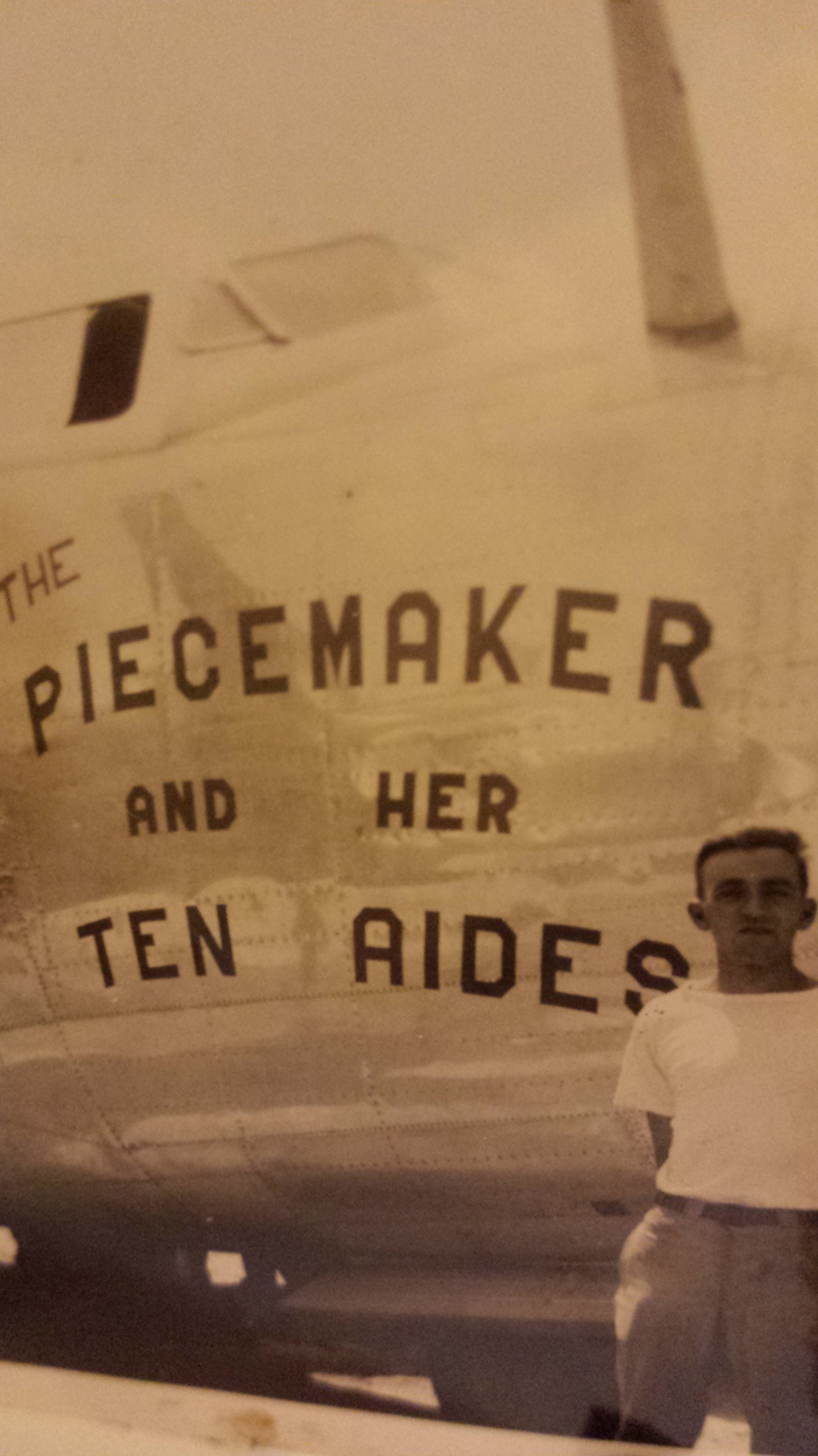
Soon we were given our own ship.” We named it the ‘Piece Maker And Its Ten Aides.’ We didn’t always get to fly it, though. Sometimes it was being repaired, then we flew whatever was available.”

2015-11-08 19.17.14

Knowing eventually about 50% of the planes wouldn’t return to base and of those 25% lost their crews, I asked my Dad if he was ever afraid he wouldn’t return. His reply surprised me.

“I never was on a mission I felt I‘d never come back from. I had confidence I would be okay. But after I came back to the states I didn’t feel that way. I lost my confidence, I thought maybe another rotation and I wouldn’t be so lucky.”

He told me that during his stay in Italy his crew never suffered a loss or injury, but the squadron lost 6 planes, and the group 29.

“We were luckier than most. As a result,” he said, “morale among my squadron was actually pretty good. “We had our share of near misses though,” my father added

His confidence would be tested many times. The first was four days after his first mission.Their destination was Bucharest, Romania and their group lost 4 planes that day, but none from his squadron.  I asked about the skill of the pilot. Had he been a factor in their survival?

“I had great faith in his skill as a pilot . He flew real well. He did have vertigo once though. We went to the right between two planes. I didn’t think we could fit in the space.”

Their tail gunner, Henry Everhart, was a bit more descriptive, that day he wrote, “We were flying along nice and peaceful when all of a sudden we peeled off the formation in the middle of a turn and did a 90 degree bank …. and went straight down……… I knew we were in a dive…we were not pulling out and thought we were out of control…..Then felt a strong force pushing me to the floor and I knew we were pulling out of a 7,000 foot dive.”

My Dad said navigation in B-24’s was done by visual sighting or dead-reckoning.

“They were just starting to use radar when I got there, only the lead plane and maybe the number two plane would have it.”

The hardest part of being a navigator he said, “was being responsible for knowing where you were. If you were in formation, you just followed the lead plane. But almost every mission someone had a malfunction and had to go back all alone. That happened to us 5 or 6 times.

But I think there was a bit more to the job than he described. The tail gunner, Henry Everhart wrote on another day, “Caple didn’t fly with us today…..only the lead ship has a navigator. I don’t like that too well. He’s a damned good navigator and knows almost ever flak position in southern Europe.”

I asked my Dad if he had ever manned the turret guns.

“I road in the turret 3 or 4 times,” he said. “The lead plane of the group carried two navigators.The second one manned the turret and aided the main one, since he had an excellent view of the ground and could more easily spot check points along the way. Though I fired a few test shots…. I never fired a shot during combat.”

His most frightening mission was one they made to an oil refinery outside of Vienna.

“Our group lost 10 planes. We were lucky we were in the lead squadron. They attacked the rear more.”

“Another mission I‘ll never forget was the one a ME-109 jumped us. He never came in front. He was on the side. He must have been the worst shot in the air. We probably had several near misses. We’d left the mission south of the Alps on the way to Munich. We had had to feather an engine and were probably flying at an altitude of 17,000 or 18,000 feet. Our pilot dove to 500 feet when we were over the Adriatic to evade him. I did see it when it was off to the side…..We weren’t sure but I think he was hit. I last saw some smoke coming out of the rear of it.

Another time the gunners kept saying they could smell smoke. The turret gunner said it was coming from the life rafts over the wings. Someone told me to pull the release cable where I was. Those that could see said one of them looked like a bunch of burnt rags as it sailed out…… We figured we had been hit by something.”

The 15th Air Force rotated crews back to the U.S after 50 missions. Some were also selected to go home half-way through their missions with the understanding they would return.

“Our crew was selected for this special rotation. “I wasn’t too happy. I had already completed 42 missions and was looking forward to having the remaining 8 by the end of July.”

They were sent to Naples on July 10th. There Dad’s orders were changed to a permanent return to the U.S.

Apparently,” said my Dad, “someone realized 42 missions were awfully close to 50.”
2015-11-08 19.26.44

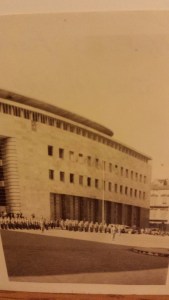
Naples Post Office-July, 11, 1944

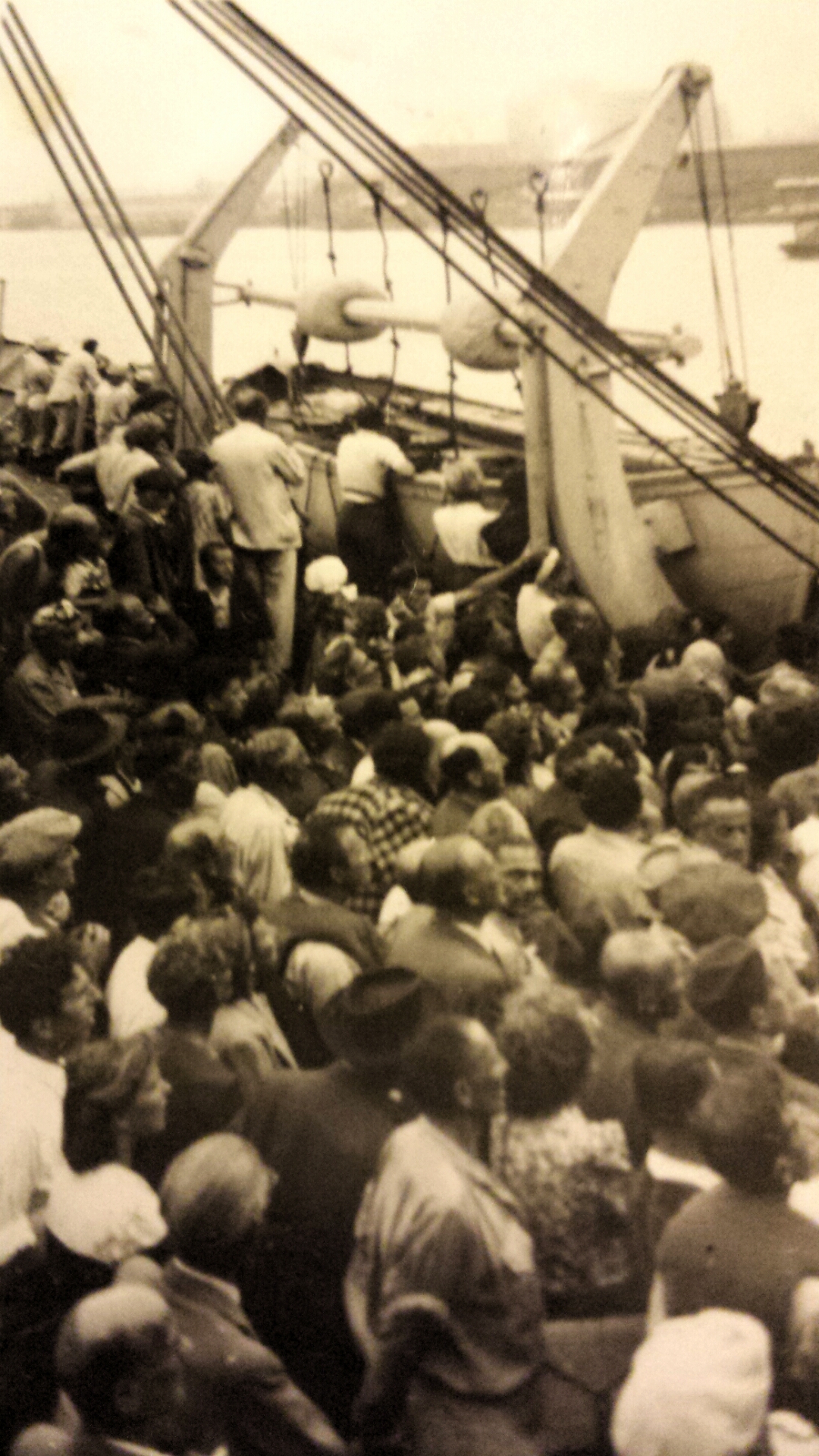
About a week later they boarded the “Henry Gibbons,” an army transport ship. Once on board my Dad soon discovered there was also a large group of refugees on the ship. Most were Jewish, most were professional people in their pre-war life and all had managed to escape internment in concentration camps. They were also the only group of refugees the U.S. government allowed to enter the country during the war.

We were kept isolated from them,” Dad recalled, “but gradually we picked up information about them. Some of the soldiers would throw cigarettes down, particularly if they were good looking girls. They were being taken to a camp in N.Y. state for the duration of the war. We were entertained by programs the skilled entertainers among the group put on. Many had performed in major theaters in Europe. The shows were much appreciated and relieved the monotony of being at sea.”

On a foggy Aug 3rd, the “Henry Gibbons” sailed into New York’s harbor.

“So many people were facing the harbor the ship was tilting,” my Dad recalled. “We were ordered to move.”
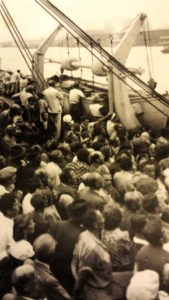
2015-11-08 19.28.12

aboard the “Henry Gibbons” as they arrive in NY

After a 3 week leave he reported to Santa Monica Ca for reassignment.

“I got the notion I’d like to be a pilot,” said my Dad, “…. I had no trouble on take offs but I did have trouble making a smart landing. ..I was eliminated from the program.”

In May of 1945 he was transferred to the Air Transport Command assigned to ferry planes back from England, in Long Beach, California.

After I got there a decision was made to dispose most of the planes in Europe. So I saw little activity while in Long Beach that summer.”

He took advantage of the free time by exploring LA. He enjoyed going to ball games and dancing to big band names. Shortly after the war with Japan ended he was discharged.

Four years after the bombing of Pearl Harbor my Dad once again was attending classes on the University of Washington campus.

I asked him, if the war had changed him.

“I think the experience matured me a lot — going just out of my teen-age years, it gave me more of an appreciation of adult life. Going back to school I wasn’t that much older than the incoming group but I felt much older.”

Finally, I asked, did he have final message he’d like to leave about his war experience for future generations?

“War is so useless,” he said, “and it’s been going on forever.”
A Visit With My Aunt Or Who Was This Samuel?

After pouring through my great grandfather Samuel Hugh’s pension file I hungered to know more.  Samuel hadn’t lived in Caple, Oklahoma until he was over the age of 45.  Clearly my Caple family hadn’t begun there.  But where were they from and when did they first come to this country?  (Note: later I would learn Caple was a post office station named for the first post master William Caple Samuel’s brother William.)

I made arrangements to meet with my Aunt Iva. After the usual hugs and greetings she walked me into the dining room where a big cardboard box sat. Inside were an accumulation of old photos and papers my grandfather had saved.  She had never seen Samuel Hugh’s pension papers so we began with those.

She was not surprised that her Grandfather had been living in Monroe, Iowa during the Civil War. In fact she’d traveled to Monroe and Oklahoma.  Unfortunately, she’d found little to add to the story we already knew.  No graves has been found matching Samuel’s family.  However she had found graves for   wives and children of a Nimrod Caple. While we ruminated, on how hard it must have been to lose so many loved ones, we wondered who he was?  Were we related and if so, how?

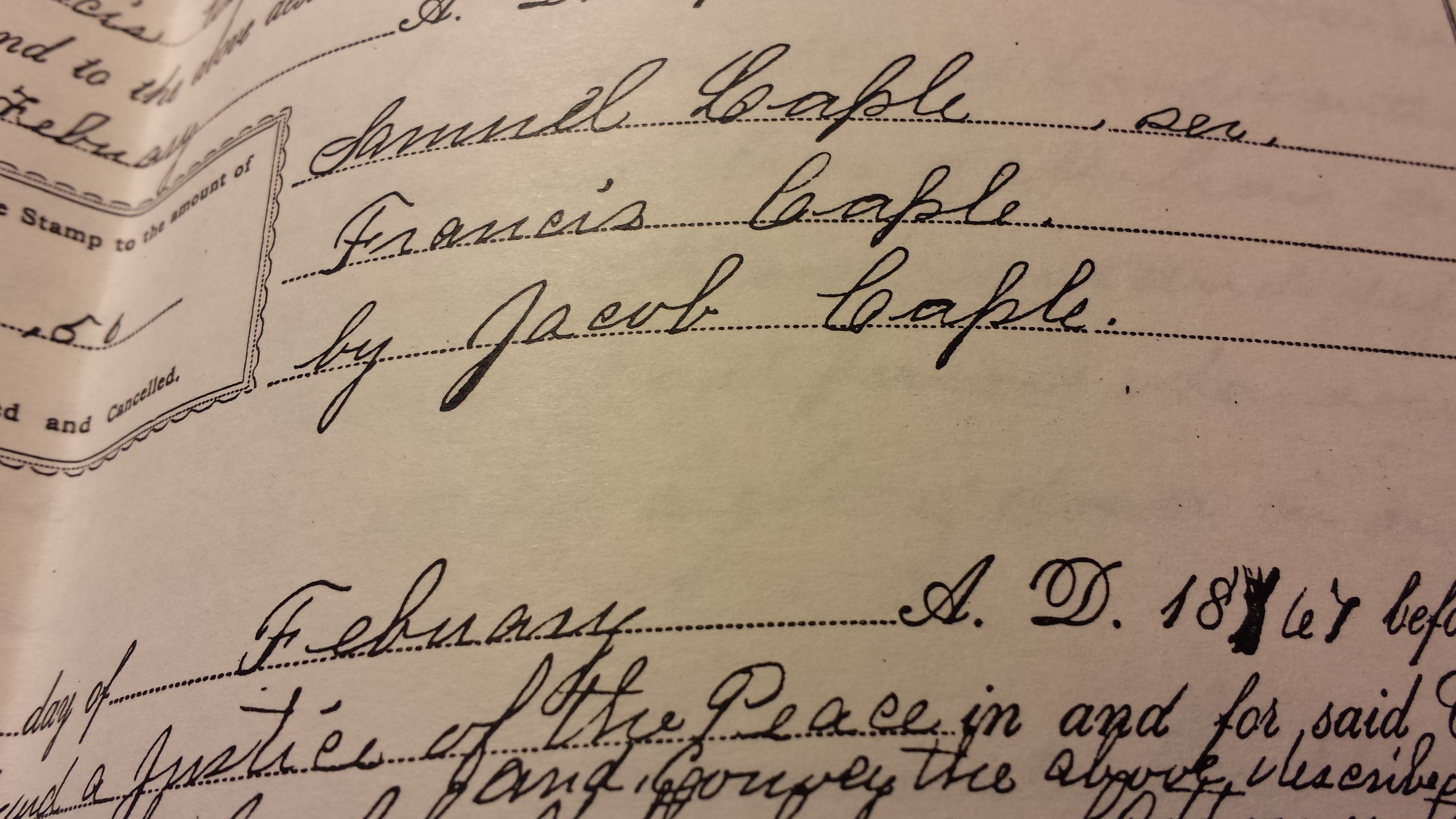
At the court house she found deeds for Nimrod plus some for a Samuel Caple with Jacob Caple having  power of attorney to sell the property. We assumed the Samuel was his son Samuel Hugh Caple.  At the end of my visit she lent me the deeds to make copies.2015-05-12 19.17.42

That evening I  sat at  my kitchen table and re-examined the documents. The first deed was for property sold in 1863, the others were for 1867.  Both my aunt and I had assumed Jacob was selling land for his son while he was serving in the Iowa infantry in the civil war. But Samuel was only 18. Would someone so young have property to sell?  And why didn’t he take care of it himself in 1867? Then I noticed something else. The deeds said Samuel lived in in Richland county, Ohio not Jasper county, Iowa. And the wife was named Francis not Polly. And besides Samuel hadn’t married until 1868. The place, names and dates didn’t add up, this Samuel had to be someone else, but who and how were we connected to him?

2015-05-12 19.13.49


Treasure Chest Tuesday

2015-04-11 22.13.29Samuel Hugh Caple -1845- 1920

Was this the outfit my great grandfather wore back when he was freighting with Buffalo Bill Cody in Kansas?

According to my grandfather, after his dad wore these buckskins for years, he decided they should be cleaned. He hired a Native American woman  who said she was experienced in cleaning leather.  They were returned shrunken and ruined.

Militiary and Pension File For Samuel Hugh Caple Examined

2015-04-11 22.13.29

I loved hearing my Grandpa Caple reminisce about traveling the Oregon trail when he was a boy. He also told  stories of his dad’s civil war experiences especially his survival of Andersonville Prison. He said his Dad had enlisted at age 16 at the outbreak of the war. Since he was underage his father had fetched him home. When he turned 18 the war was still going and he enlisted again.  Apparently, he soon had second thoughts but this time he had to stay.

He told me his dad was wanderer always thinking the grass was greener somewhere else, never staying in one place long until his wife put her foot down and refused to move again.  Stories of how his Dad had worked with the likes of  Buffalo Bill Cody and Wyatt Earp in Dodge city fascinated me.  He told me we’d be rich if his dad hadn’t somehow lost his claim on most of what is downtown Spokane.

But when I asked where the Caple’s had come from; the only thing he recalled his dad saying was they had come from the south. Once slave owners they had sold the plantation moved north after deciding slavery was wrong.

Now I had his father’s, Samuel Hugh Caple’s, service records along with his and his wife’s pension files.  What would they tell me?

First there was a description of Samuel. At  5 ft. 7 inches he wasn’t a tall man but I bet his dark hair, fair complexion and blue eyes turned a few heads on the girls when he was a young.

He had served as a private in the Iowa 5th volunteer Infantry, Company B and later in the Iowa 5th Cavalry.  He had enlisted for 3 years on 11 Sept. 1863 in Vicksburgh Mississippi receiving a 100 dollar bounty for enlisting.

His unit had taken part in the Battle of Mission Ridge on Nov 24th and 25th of 1863.  They had been furloughed to Davenport, Iowa from April 8th to May 7th 1864.

On Augut 8, 1864 he was transferred to Co. I, Iowa 5th Calvary at Long Pond, Georgia (the reason was the 5th infantry and 5th Calvary had suffered huge losses and thus were combined into the 5th Calvary.)

He was absent on detached service for Dec. of 1864 and January 1865 working as a teamster since 12/64 which meant he was most likely involved in carrying supplies for the troops.

He was mustered out of service on Aug. 11, 1865 in Nashville, TN.

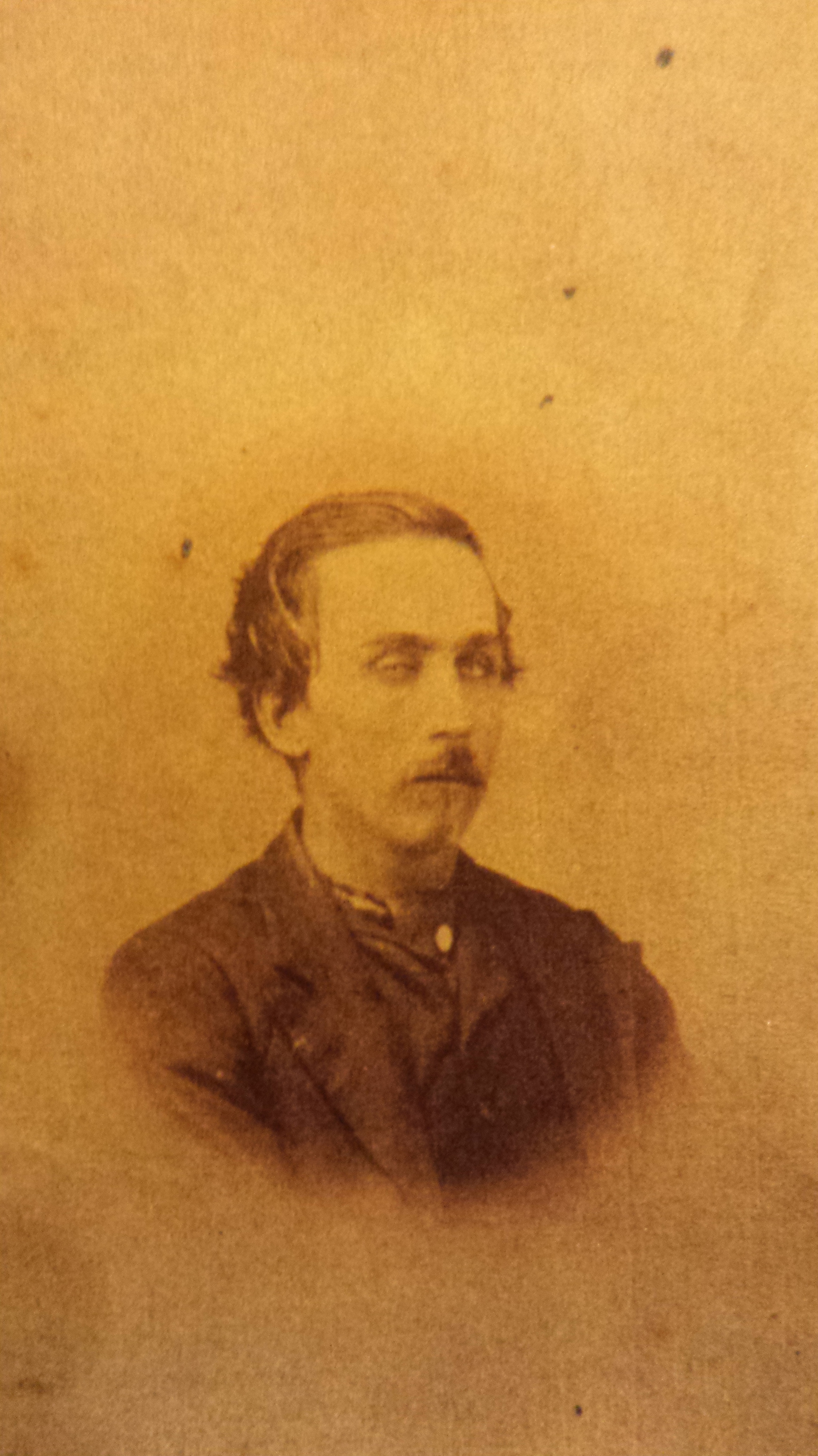
2015-04-11 22.12.48I was told this photo of Samuel Hugh was taken right after the end of the Civil War. Supposedly he had a husky build when he enlisted but as a result of his imprisonment had returned home a much smaller person.

He had  applied for pension three times. His wife Margaret applied for a widow’s pension after is death.

He was born in  Mt. Vernon, Ohio on March 28, 1845 to Jacob Caple and Sarah Ann Garey. At the time of enlistment he had been living in Monroe, Iowa and lived there afterwards until 1876. He had also lived in Dodge City, Kansas, Puyallup, WA and Oklahoma.

2015-04-11 22.11.52

His first  application for a pension was made in March of 1894.  At that time he was living in Caple, Oklahoma. He stated that he was unable to support himself by reason of rheumatism and piles and also heart, spleen and liver complaints.  He wrote that he had first aquired spleen and liver complaints March of 1865 in Selma, Alabama, due to exposure.  The rheumatism had started in 1873 and he had been troubled by piles or 16 years. This application was witnessed by a W. M. Edwards and Richard B. Quinn. In another document both of these parties swore that they had known Samuel for 25 and 1/3 years as of March 1894.

There was a doctor’s avadavidit stating that he suffered from Rhuematism, Hemorroids and chronic endocarditis and enlarged spleen from June of 1895.

This application for pension was denied.  In 1898 he again applied.  In this application he stated that he had married Margaret (Maggie Ragsdale) in Brookline, MO, on Sept. 16, 1877 and had previously been married to Polly A. Caple who had died on June 10, 1876 in Monroe, Iowa.

He listed his living children as Milo age 23, Minnie age 30, Samuel age 19, Joe age 14, Roy age 12 and Richard age 8  ( Note: one more  child, Lida would be born in 1899). This application was also denied but when reapplied in 1912 it was accepted.

In Dec. of 1920 his widow Margaret applied for a widowers pension.  Among the papers in this application was a copy of his death certificate. His address was given as 510 16th st. S. E. in Puyallup, WA. His date of birth was verified as being March 28th 1845.   He was age 75 years, 8 months and 8 days. It confirmed his place of birth as Mt. Vernon, Ohio and his parents were listed as Joseph Caple b. in Maryland and his mother as Sarah Gery also born in Maryland.  The informant for this information was listed as his wife Margaret M. Caple.

He died on  Dec. 6th 1920 at 10 a. m. The cause of death was diabetic gangrene of
the foot and he was buried in the Orting Cemetery, Dec. 8 1820. Margaret also
gave their marriage date and place of marriage as previously stated.  She had had
been born, March 31st. 1858  near Brookline, Green County, Missouri.  Her
pension request was accepted.
 Now that I knew more about Samuel Hugh Caple  my appetite to know more was
whetted. He’s said his parents had been born in Maryland.  Was Maryland
considered a southern state? A quick look up told me it was. Had this been the
state of the old family plantation?  Had there ever been one? Or was the story of
moving north because of opposition to slavery just  been told to make the family
sound good.
 And who exactly were his parents? Why had they moved from Ohio to Iowa?
To answer these questions I would need help. The first two thing I did was buy a
book on researching your ancestry, next I talked to my Dad. He didn’t remember
much more. He suggested I call my Aunt Iva he was pretty sure she could tell me
more. I scheduled a time to meet with her as soon as I could spare time to travel
to Bremerton for a day. In the meantime I decided to see what resources my local
library held. While there I made two discoveries. Their collection included a book a
Caple family of Maryland.  Were these my ancestors? And I had found a Samuel
Caple who had served in the Revolutionary war. Surely I would have heard about
such an ancestor.  But he was named Samuel, could he be an ancestor?
To answer these questions I had a lot of work to do.  First I had to start with what
I did know and work my way backwards.  Time to do more research on my great
grandfather, Samuel Hugh Caple and his father Jacob.


Finding Caple Oklahoma Or How I Got Bit By The Genealogy Bug

2015-03-30 19.51.53

I pulled the thick packet out of the mailbox – return address National Archives, Washington  D.C.  The Civil War military and pension records for my  great  grandfather, Samuel Hugh Caple, had arrived. I crossed my fingers  and opened it hoping the information my Dad wanted was within.

Growing up both my Dad and I had listened to stories about how his grandfather, Samuel Hugh Caple, had survived being a prisoner in the notorious southerns Civil War prison – Andersonville.  My Dad had even spent a day spent a day touring the former prison site.  There he learned if he could show documentation of Samuel’s being a prisoner his name would be added to the the list  of survivors.

Unfortunately the papers from the National Archives did not have the record he desired but it did contain other valuable family information.

Other than the civil war stories I never heard tales about my Caple ancestors, except one.  My grandfather said the family had once been plantation owners somewhere in the south and had moved north because they didn’t believe in slavery. He didn’t know which state nor had any idea what country they may have come from from originally.  Someone said the name sounded German so he thought maybe they had come from Germany.

Among the many papers in the packet were affidavits from several people who said they had known Samuel while living in Caple, Oklahoma.

I recalled my grandfather mentioning he had lived in Oklahoma for a time while a boy.  But he had also said his father was a wanderer and they never lived anywhere long. So where exactly was Caple, Oklahoma?  How come I had never heard of it?  If my great grandfather had lived there, once upon a time, was this the southern state  the family had come from? Wy was it called Caple?  Outside of my family I had never even met another Caple.

  I set out to find the answer. I told myself I’d just find out where Caple was and how it got it’s name. I had no intention of doing more.

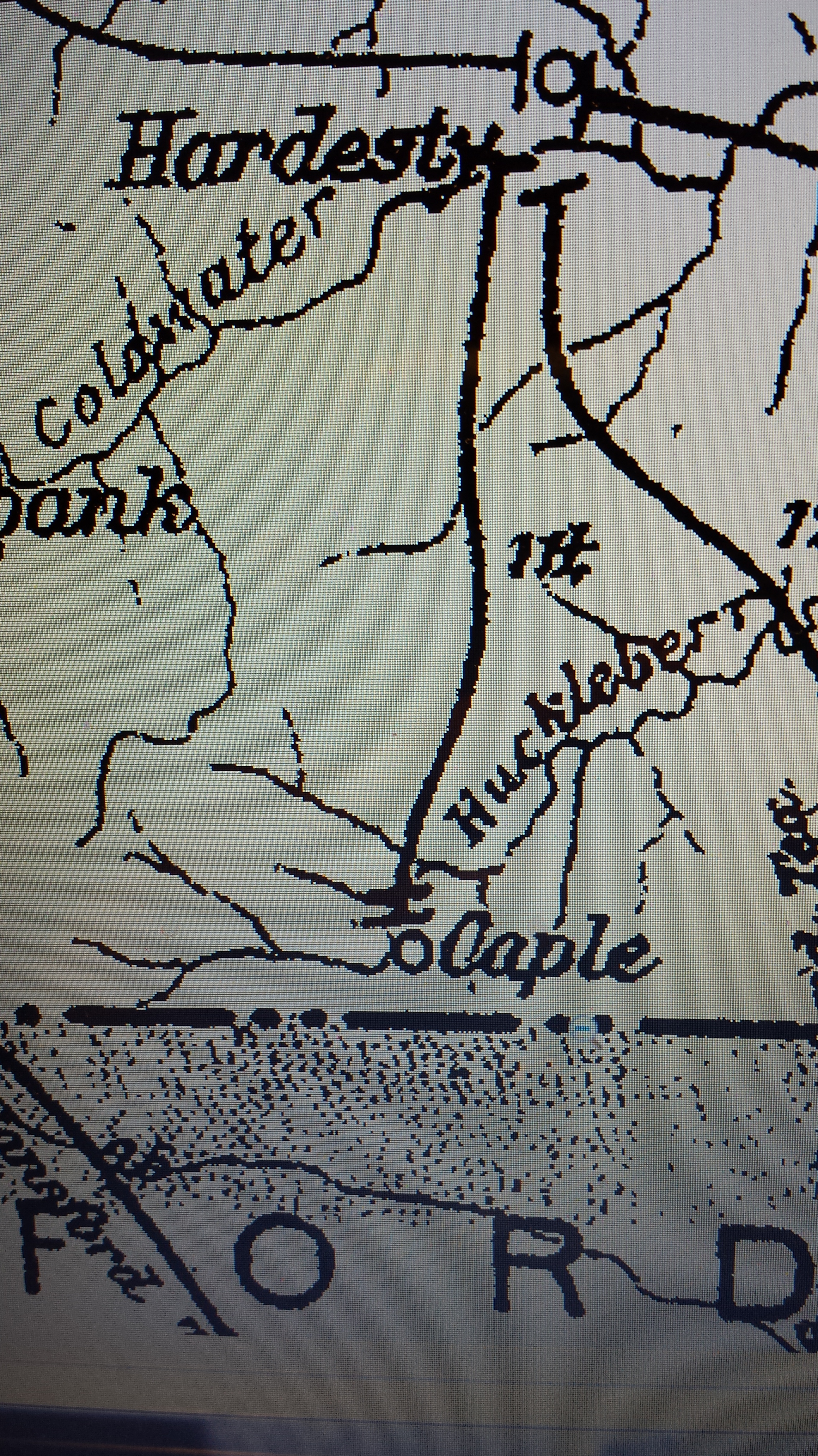
The archive’s papers showed Caple as being in Beaver county, Oklahoma.  I looked for it in a current atlas.  It wasn’t there but an 1899 Atlas, I had purchased at a yard sale, did  have a Caple,  Oklahoma.  It was in the southern portion off Beaver county (now Texas county), south of Hardesty, near the Texas border.

But I still didn’t know why it was named Caple?  And what had happened to it?

Today a search on the internet would give me the answer but in 1993 other avenues had to be pursued. I needed to learn how to trace my family history and thus began my affliction with the genealogy bug.  


The Schleiss Family


2014-07-02 19.48.43

Maria Schleiss Uelmen

It has been a while since I made a posting. Life changed for me and my siblings when we lost our beloved Father two days after Christmas.This will be my last installment (for now anyway) on the extended Meyer/ Uelmen family. Next I will turn my attention to my fraternal side of the family.

Josef Schleiss b. 1819 and Catherina Prausa b. 1825 — Maria Schleiss b. 1857 – Rosalia Uelmen b.1891

Year: 1868 

Place: a village somewhere in the Pilsen region of Bohemia (now the Czech Republic).

The family: Josef Schleis, wife Katherina Prausa and their 5  children – Anna b. 1850, Catherina  b.1852, Maria b. 1857,  Franz, b. 1859 and Josephine b. 1864

Eleven year old Maria Schleiss skipped home on the way she noticed the men, who came every year telling of the good fortunes to be had in America, had returned. They made her think of her uncle who  lived there. She had never met him but from time to time he wrote letters glowing with the reports of the good farmland. and the ease of obtaining citizenship. Two years ago, after Prussia had begun to occupy their country, her aunt Barbara’s family had joined him. Maria thought the place was called Wisconsin. Her mother and father had discussed going with them but lacked the funds to make the move. Maria hadn’t minded she wasn’t so sure she wanted to move to a strange place so far away, even if they did have family there.

Once home Maria opened the door of her house. How strange, her parents and two older sisters were sitting at the table even though it wasn’t meal time. Her father held a letter and another piece of paper. Seeing Maria her sister Catherina jumped up. “Uncle Prausa has sent us a bank draft. We  are going to America.” From that moment on Maria’s life would never be the same.

The next weeks and months were busy ones. Very little could be taken along so most of their property needed to be sold or given away. Finally the day had come for final tearful good-byes. Maria looked longingly at the village she’d been born in and the friends and family gathered to say good-bye.  With tears in her eyes she to took one last look and then turned and left her life in Bohemia forever.

The family made their way to a train station where they boarded a train that would take them to Bremen (now in Germany). There they boarded the ship Gessner for the voyage to America.

Below is the ship passenger record for the Josef Schleis family. The ship Gessner departed from the port of Bremen and arrived in NY on July 15, 1868.  Josef’s occupation is listed as a weaver.

NYM237_298-0207 (2)

Like the Uelmen and Meyer families they most likely made their way to Northwestern New York where they boarded another boat that would take them across the great lakes to her uncle in Kewaunee county, Wisconsin. Since Kewaunee borders Lake Michigan they were probably met by family or were able to arrange for immediate transportation to Katherina’s family in Carlton township.

In  1870 the census, shown below, shows the family living in Carlton Township of Kewaunee county.4268465_00741

Josef and his wife are listed as laborers. Directly above his listing is one for Katherina’s sister Barbara and her husband Mathias Rutka. The Shleiss family carries over to the next page where child Frank, age 11 is listed as well as a new child, Theresia, age one. Also on this page  is Katherina’s brother Josef Prausa.

The 1880 census shows the family is still living in Carlton township. Joseph is now listed as farming. Maria is no longer living with the family as she married Peter Ulemen in 1877 and was living in Auburn township, Fond du Lac county.

In 1896 Maria’s mother, Katerina died and is buried in St. Joseph’s cemetery, Norman, Kewaunee County,  Wisconsin. Her  father, Josef  is found living with his son Frank in Carlton township, Kewaunee county. He died died in 1908.

From The Kewaunee county Enterprise News from Carlton.

Mr. Joseph Schleiss an old resident of the town died last Saturday night after a short illness.  The deceased was 89 years old and buried in St. Joseph’s cemetery. Mr. Schleiss moved to this county from Bohemia forty years ago. He is survived by three daughters and one son.

notes: Although I have no absolute proof that Joseph Prausa and his sister were Catherina Prausa’s siblings the evidence for it is strong. Maria’s children said her uncle Prausa provided the money for their passage to America. There are no other Prausa’s living in Kewaunee county during the time period of their immigration. Joseph Prausa had emigrated about 1855 giving him time to save enough money for the family’s passage. Further more they are found living within close proximity of each other in both of the 1870 and 1880 census.

A Squirrel For Christmas

2014-10-26 12.43.38

(This story was written by Mother about her most memorable Christmas.  I think she was probably about 7 or 8 when this story took place.)

The oldest member of our family, my brother John, as a young teenager, trapped muskrats on the Milwaukee River which bordered our farm. The fur from these animals provided him with spending money.

Around noon,on the day after Christmas, he walked into the house carrying a very stiff, motionless squirrel. John had returned from checking his trap line and had found the squirrel caught in on of the traps.  Mother said, “He appears to be frozen.  Put him in the box behind the cook stove.  As soon as you’ve changed your soiled clothes and get warm, you can carry him outside.  Later you can carry it to the garbage dump.

Imagine our surprise when sometime later we noticed movement in the box. The squirrel wasn’t dead after all.  It was just stiff from the cold.

Soon the little fellow was up and about, but his back leg was broken. We carried his box to the Christmas tree.  We felt he’d feel more at home under a real live tree. We added some soft clean rags to his nest and fed and watered him.

Finally he became strong enough to leave the box and scamper up and down the Christmas tree.  His movements shook the tree just hard enough to make the ornamental bells tinkle.  Sometimes he’d venture out on to a brand, chattering and scolding us.  That made us literally squeal with delight.  When he tired of tis activity he’d return to his box, curl up and go to sleep.

We never tired of watching him.  All of had high hopes that his leg would heal enough so he could return to the outside world.

We enjoyed him for 3 days.  One morning when we went to check on him we found his little body stiff and lifeless.

We all felt saddened by this turn of events. That little furry fellow had given us so much pleasure and made that Christmas truly memorable. How many children get to have their very own squirrel for Christmas?