Category Archives: Uncategorized

Christmas Memories

2014-12-02 17.44.38

CHRISTMAS REMEMBERED
By

Jeannette Claire Meyer Caple
(These stories were among stories among rough drafts my Mother was writing for s life writing class. Her teacher liked the squirrel story the best and so that was the one she perfected but I like these memories better. Some of these drafts may have had lost parts others had more than one version. I used the one that seemed the most complete. I think these were written in 1987)

Christmas was a time of great anticipation. I believed in Santa Claus much longer than children do today. I lived in an age of such innocence it was easy to be fooled. I had never seen a department store Santa Claus. The only Santa Claus we ever saw was the one that came to the schoolhouse the night of our annual Christmas program.
The Christmas program was the highlight of the school year. A teacher was judged by the way she utilized the talents of all eight grades of children. This was no small feat since she somehow had to incorporate the little children with the middle-sized ones and the big ones. Then there were parents to consider. Hell has no fury like that of a parent who feels his child has been left out. For a month before Christmas vacation, we practiced. We even had a stage curtains that opened and closed. Everyone that was big enough to pull the ropes wanted a turn. I made one feel so responsible. We usually had a Christmas pageant about the birth of the Christ Child. This did not cause a bit of trouble, as everyone in the community was a Christian.
After the program ended, we children would be able to hear sleigh bells in the distance. We knew Santa Claus would soon be coming into the classroom. Santa arrived amid much stomping and hearty ho ho ho’s and always an appropriately red nose – probably from waiting outside in the cold Wisconsin weather for the last of the program to be finished. He was always very rotund. Sometimes when the fattest man in the area who must have weighted over 600 lbs. was Santa, there was no need for pillows. On his back, he carried a burlap sack filled with bags of candy and nuts for all the children at the school.
I remember the time my favorite doll disappeared a few days before Christmas. I couldn’t find her anywhere. I ran crying to my mother saying, “I can’t find my baby doll anywhere!” She consoled me and said, “Don’t worry honey; I think Santa took her because he wants to make her some new clothes.” This explanation totally comforted me and I went about the day happily playing with my other dolls. I trusted Mother and Santa Completely.
On December twenty-fourth, my Dad would set up the deliciously scented balsam tree in a corner of the living room. Our house always had one rule regarding the Christmas tree. It had to be tall enough to touch the ten foot height of the ceiling in the living room. Santa would trim it when he came during the night. Never in the years, my siblings and I believed in Santa, did we ever see our parents trim tree. Even after we were all too old to believe in the kindly old gentleman in the red suits was the tree ever trimmed before the twenty-fourth of December.
The four weeks before Christmas were used to prepare ourselves for the birthday of Christ. It was called the season of Advent in the Catholic Church. The week between Christmas and New Year’s was the time for celebration.
Mother and Dad encouraged a very early bedtime on Christmas Eve. We happily cooperated. After all Santa had so many houses to visit, we had no wish to impede his progress. Soon after snuggling down in bed, I’d hear the tinkle of bells. This phenomenon occurred because my parents were loudly ringing ornamental bells as they hung them on the tree. I imagined Santa was in the living room trimming the tree with that happy thought I’d fall soundly asleep, lest he catch me awake and not leave any gifts.
Early on Christmas morning my parents would shout, “Wake up! Santa has been here!” In a second, we would all be out of bed and running downstairs to the living room. Was there ever a more spine-tingling sight than the Christmas tree, as it stood in all its beauty aglow with the ornaments and tinsel?
Gazing upon the gifts under the tree, I spied a doll. Oh-h-h she was beautiful all dressed in a pink organdy dress, trimmed in lace with a matching bonnet and booties. Her little fat rubber arms stretched towards me. I grabbed her and hugged her tight. It was only then that I realized she was my old baby doll come back to me. This realization did not detract from my happiness in the least. I was just thrilled with her and now she was as pretty as a brand new doll. I know I received other gifts that year but I can’t remember them, so complete was my joy with my precious old baby doll.

Candy on the Tree

Every year Santa hung delicious candy among the ornaments on our huge Christmas tree. After all the presents were opened we children would walk around the tree counting the pieces of candy that hung from the branches. There would be various flavored stick candy chewing gum licorice pipes, chocolate Santa’s, suckers and candy bars. One memorable Christmas Santa added chocolate covered mice that were hung from the branches of the tree by their chocolate-coated rope tails. During the night, the coal furnace over-heated. The house was in no danger of burning, but by the time Dad got the fire banked and under control the house had warmed up to a considerable degree. The chocolate covered mice got very soft and started to sag. Their marshmallow bodies stretched far out from their long tails giving them very ridiculous appearance. We hall had a lot of fun laughing about our now strangely shaped candy mice. But they tasted just as good as ever.
A Christmas tree hung with candy is somewhat like having your very own candy store. Mother allowed us to untie a piece anytime as long as we were considerate of the rest of the family and didn’t pig out by eating more than our fair share. I forgot that admonition one year and ate lots of Hershey bars. Later that evening I became dreadfully sick to my stomach. What a lesson! I never ate another chocolate Hershey bar until I was over thirty years old.

In speaking of her mother’s sewing she wrote…….

One year for Christmas, she gave me a six gored wool skirt that she made out of a huge woman’s coat. I loved it. I was so thin and tiny and it looked well on me. She also made me a pink batiste blouse from anther discarded dress. I especially appreciated this because I know how she labored to do this. She got up in the morning before anyone else arouses to make these things as a surprise gifts for me. I can’t begin to mention the many things she made for me but the outstanding ones were to be my wedding dress and veil and a fur muff and hat.

The next one is about our family Christmas when I was young, mostly the 1950’s,

After Thanksgiving had come and gone in our household, we were beginning to prepare for Christmas. The children were eagerly awaiting the package delivery truck. ( Note – I fondly remembers this. It’s arrival meant the Christmas season had finally arrived).
Each Christmas there was a big box from Grandma and Grandpa Meyer or as the children always called them Grandpa and Grandma Consin. This expression started with the oldest were little children and when we spoke about their grandparents in Wisconsin. Wisconsin was such a mouthful so it was shortened to Consin and from then on until they were well grown-up, they were always known by that moniker.
Their Grandparents did not have much money to spend but everything in the box was made with love and even the smallest child sensed this. At last, the day would arrive when the express left the big Christmas box that was opened up by degrees. The individual gifts were left in the box and were opened on Christmas Eve after we had dinner and the children had their baths. But Grandma always tucked in things to be had immediately. There was always a container of hickory nuts meats usually in a new Tupperware container I could use later in the kitchen. This was grandpa’s contribution. In the fall, he would pick and  crack them.  Mother always tucked in stockings filled with treasures for the girls. Things she knew they would love like pencils, their own tape etc.  These they were allowed to open before Christmas.  And there was always a box of homemade cut out cookies of ginger and anise.  These would be our dessert one night before Christmas.

LEAFING OUT

My Mother wrote this story in 1984. We visited WI when I was four and six. I too remember climbing up those up those stairs for  my first dental exams. Fortunately for me no cavities where found.

“Do what you know you must do as soon as you can” was a favorite quote of my Mother. She never quite put it in these words but nevertheless I always got that message.

One of the things I knew I must do was visit the dentist. Now the dentist happened to be my uncle. Whenever he came to our house to visit he’d examine my teeth for cavities. It seemed he  ALWAYS found cavities. He’d tell my Mom  (his sister) that I was to come to Campbellsport and spend a few days in town with him and his family.  He’d work me into his schedule between paying patients. What this meant was I could play with my cousins everyday and when he had some free office time he’d telephone and I was to come to his office.  I had to walk about 6 blocks from his home to his office which was above the village bank.

Dentistry hurt in the days before the high speed drills so you can imagine how I hated going to get my teeth fixed.  I could smell the disinfectant and can to this day.  How I wanted to run down those steps and go somewhere else -anywhere else! Eventually I was ushered into his office where clung to the arms of the dental chair, wound my legs in a knot and prepared myself for the hurting I knew was coming.

Fortunately, I knew my uncle to be a kind soft-hearted man.  Deep down inside I knew he could not prevent all the pain the dental work caused if he was to fix the deep cavities I had. I made the trip 3 or 4 consecutive days. Then I would happily go home again.

Lucky for me my Mother made me do what I had to do because today I still have all my teeth and think of that as a gift form my uncle.

Many times during my lifetime when I’ve found something I must do that I’d rather not do, I imagine myself as a young girl climbing the steps to the dentist office because after all, “It was something that had to be done.

A wise woman – my Mother.

Leo Uelmen my Mother's uncle and dentist. l

Leo Uelmen my Mother’s uncle nd her dentist.

Throwback Thursday

Have you ever spent more money on a piece of clothing than you really wanted? I can a think of a couple of times I did because I loved it so. And each time I got more than my money’s worth out of it as I wore it for years. This a story my Mother wrote about a outfit she purchased in 1941. She wore it for years and then my sister and I both wore it. The jacket now resides with my sister.

My Mom in her indestructible snowsuit.

My Mom in her indestructible snowsuit.

THE INDESTRUCTABLE SNOWSUIT

“Mother, I just love this old jacket of yours that I am wearing. I hope it never wears out completely. Do you know whenever I wear it, someone asks me where I got the pretty jacket?” remarked Kathy.

We both chuckled as I gazed at my lovely daughter it takes me back to the time when I was her age and size.

I had graduated from Sheboygan Falls Normal School in the state of Wisconsin.  (This was in the era of one room schools). It was the fall of 1941. I would soon be starting my first year as a public school teacher.

Between graduation in late May and late August I had earned my very first money waiting on tables at and expensive summer resort in Elkhart Lake, Wisconsin. I needed every cent of the money I had earned to buy clothes befitting a teacher.

The most needed garment was something in warm outer wear to see me through the long, cold and snowy Wisconsin winter. I had not earned enough money to cover all the clothes I needed, but my first priority had to be a 2-piece snowsuit.

My Dad and I drove to Fond Du Lac one day. This was our closest big city and had many fine department stores. On the way I imagined the kind of outfit I would buy. It had to be serviceable and warm. I also hoped it would be pretty. I so loved pretty clothes and now I had my own money to buy them. It was a heady feeling.

I trudged from store to store. I became more and more disheartened as I looked through the racks of snowsuits. This clothing item was going to get very rugged wear through snow to and from school besides I planned on sledding with my students on the hill back of the school.

Why did all the snowsuits that were warm and serviceable also seem to be so devoid of all style. Only the price of $14.95 was right.

I kept shopping. As I walked into one of the better stores, I saw “The Snowsuit.” It was beautiful and seemed to say, “Here I am. Just what you’ve been looking for.” The pants were made of dark green wool and the jacket of a soft, mint green. My favorite color! It had sleeves that were gathered to a knit cuff and tiny puffs at the shoulder. A full length zipper ran down the front. The front of the jacket had a yoke on which were embroidered pretty flowers.  A matching belt completed at the waistband completed the look.

I was afraid to look at the price because I knew it was no $14.95 model. I was right it was $19.95.  Five dollars was a lot in those days.  I turned around and went back to the store with the warm serviceable garments. They looked positively ugly now.

I fairly flew back to the store that had the green snowsuit.  I took it into the dressing room and  tried it on.  Just I imagined it was the prefect fit and made me feel beautiful all over. Did I dare buy it?  My common sense told me the virgin wool  material would be warm but the mint green color was not exactly what one would wear to carry wood to the school furnace to day nothing of the dirty job of carrying out the ashes.

I just couldn’t bring myself to part with  the green snowsuit.  I decided to throw caution to the wind and buy the one I liked.  After all, I had earned the money myself, hadn’t I?

When I got home I showed the purchase to the family.  They  all hit the ceiling.  My brother who was  25 said I showed no sense at all by putting beauty  before serviceability.  I shrugged it off because he wasn’t known to ask for my opinion when he bought something.  My  Dad yelled something about my foolish purchase.  Even, Mother who always taught me one good garment was worth two cheap ones thought I had made a  big mistake.

Ordinarily, all that negativity would have crushed me. This time it didn’t. I simply loved my snowsuit and nothing would  detract from that.

I wore it happily for seven years.  The pants wore out but the jacket just kept going on.  It kept me warm.  When Verle and I came west so did the snowsuit jacket.

During the years the four children grew up it resided in the cedar chest except for the  days when Longview had snow. Then I would wear it and help the children build snowmen. It still  kept  me  warm.

Treasure Chest Tuesday

2014-10-26 12.43.30-2

This is another treasure I inherited from my Mother. It was made by my Grandma Rose Meyer. My Mom brought it home when they left the old farmhouse. Mom loved it but she never did display it, for  years it sat upstairs rolled up in a corner. I can’t see the sense of having something if you can’t enjoy it, so I display it on the back of a seldom used love seat. At this time of year it echoes the colorful leaves of red, yellow and orange outside my windows.

The rug was made in the 1960’s. The design is original. My grandmother used the beautiful fall trees in her yard for inspiration. It is made of wool probably of old wool she collected. My Grandma Rose enjoyed making things out of cast off things.

Which Johann is it?

In days gone by our ancestors  named their children after grandparents, parents or aunt and uncles.  This meant cousins of similar ages often had the same names. In Germany it also wasn’t uncommon to give all the of the children the same first name and a different middle name. They usually went by the middle name but in official records they might be listed with both names, the middle name or just the first name. This can make sorting who is who confusing.

This confusing name pattern exists within my Uelmen family.  Mathias Uelmen, the father of my immigrant ancestor, named his sons Johan Mathias, Johan Adam and Johan Adam. (Yes, that is right, two sons with the same name first and middle name) To make things more confusing all three Johan’s settled in the same area of Wisconsin and each named a son Johann Adam as well as repeating the names Joseph, Peter, Nicholas, John, Adam, Mathias and William.

Years ago I ran across the newspaper clipping posted below. At first I was excited, I thought I’d found my immigrant ancestor, Johan Adam’s, obiturary but though the history was similar the birthdates etc. didn’t match up. So who was he?  I thought he must be related but couldn’t place him in the family.

I recently ran across the clipping again while reviewing my Uelmen files only now I had more information on the three immigrant brothers. I quickly figured out he was the son of Johan Mathias which made him Johan Adam’s nephew. The obituary tells us that the first Uelmen’s in the family arrived in 1844, 13 years before my Johan Adam.  It also gives us clues as to what our ancestors journey must have been like as well as the family homestead was near where my great grandfather Peter first lived.

The Johan Adam in this clipping was my great grandfathers Peter Uelmen’s first cousin. For some time I was aware that the town of Campbellsport had once had  two dentists with the Uelmen surname . Leo Uelmen( my great uncle) and a older Peter Edwin Uelmen.  I’d asked my mother about this Peter.  She remembered his name him but said as far as she knew he was of no relation.  Still, I thought it odd that a small town would end up having two dentists with the same, less than common, surname with out them being related.I did a little more research on the Johan Adam in the obit. It turns out  his son was the dentist – Dr. Peter E. Uelmen.  The two dentists were related after all. I am sure my great grandfather Peter must have know his cousin Johan Adam well.  So did his son Peter E. Uelmen, influence my Peter’s son, Leo to become a dentist? Maybe somebody out there knows.

Campbellsport News, January 3, 1918

PIONEER CALLED TO THE GREAT BEYOND JOHN ADAM UELMEN DIES AT HOME ON MAIN STREET AFTER LONG ILLNESS

  Wednesday forenoon at 10 o’clock the final call was made for John Adam Uelmen, one of our oldest and most highly respected citizens. Mr. Uelmen was born in Germany on October 8th, 1836, and came to this country with his parents when seven years of age. They landed in New York on the 8th day of July, 1844. They started west by way of Albany and Buffalo Canal, through the Great Lakes by boat and landed at Racine.  From Racine they walked to Saukville, where they bought a farm and lived ten years. They then moved to Lake Superior in the copper region, where Mr. Uelmen was employed in the mines for three years. Later, he with his wife whom he married in 1855, came by boat to Sheboygan, locating near New Fane, where they lived on a farm until April 1st, 1863, when he and his family moved onto the old homestead one mile east of this village. In November, 1902, Mr. Uelmen retired from active labor and moved to the home on east Main street in the village. The deceased is survived by three sons and one daughter, John and Joseph residing on the old homestead, and Dr. P. E. and Mary Uelmen at home. Five other children proceeded him a number of years ago. The funeral will be held tomorrow (Friday) morning at 10 o’clock from St. Matthews’ church, Rev. Father July singing High mass. Interment will take place in the Union cemetery, the remains to be laid beside those of his wife, who preceded him in Semptember, 1909. The pallbearers will be Nick Hahn, Henry Leibel, Sr., John Granger, Michael Farrell, Stephen Bonesho and Joseph Van De Grind.

ak_1918_jan3.gif (20782 bytes) (Scan courtesy Alan Krueger)

Treasure Chest Thursday

Rustic Vase from My Grandma Rose

Rustic crockery vase belonging to my Grandma Rose Uelmen Meyer

Treasure chest Thursday means it’s time to share a family gem.  Yes, the sunflowers are pretty but the crock is the focus of this piece. Mom gave this to me several years before she and my Dad moved out of their house.  She knew I’d appreciate it’s rustic charm.  It’s my favorite vase for country bouquets.

I find it kind of strange though, that my Mom  chose this as one of the few things she could take from the family farm. Living in WA state limited how much she could bring home and she didn’t really care for the rustic look.

Although you can’t see it in this photo the crock does have a chip along it’s rim. It was the sort of thing she’d say when shown, “Who’d want that old thing.”  This piece must have must have spoken something about her childhood home and mother though, I guess I should have questioned her more.

She did tell me that her Mother found this piece while poking around in a vacant lot across the road from the church they attended. (ST. Mathias Catholic Church, Auburn Township, Fond Du Lac county, Wi)  According to her a  German convent had once sat on the property.  She figured the crock was something they used.  She told me the convent had been long gone by the time she was born.

So my question to you is – what kind of family treasures do you keep? Feel free to share in the comment section.

Letter from ST. Michaels, WI to Strohn, Germany

Below you will find an very informative letter written in 1846 by Michael Rodenkirch to his friends and family back in Strohn, Germany.  He goes into great detail on the trip to Wisconsin, life in Wisconsin at that time, and what to think about if you were planning to come yourself.  This letter and others like it surely influenced our Uelmen family in making their decision to immigrate to America, specifically Wisconsin.

At the time this letter was written John Adam Uelmen had been married 7 years and had 4 children.  His older brother Mathias had arrived in Wisconsin about the same time as Michael Rodenkirch.

I have left the spelling the way it was written in the original text.  This letter first came my way from a posting made on Rootsweb by L. Mcatanz.2014-08-25 16.24.46-1 Photo is of Schalkenmehren,Germany


State of West Konsin

December 26, 1846

Dearest Mother, All Sisters and Brothers, Brothers and Sisters-in-law, Relatives and Acquaintances. Sincere Greetings to you All.

Thanks to God we are all well, and hope the same of you. I do hope that by now you have received my letter of Oct. 22, telling you where we have finally landed. Should you have received this letter, I hope that news from you is on the way. I will tell you again briefly about out trip.

Emigrants to America generally pay half fare from Cochenn to Coblenz, 10 silver from Groshehen; from Coblenz to Coeln, 20 silver Groschen; from Coeln to Antwerp by railway, two dollars per adult person, older than 10 or 12 years children below that age pay half fare, and babies under one travel free. From Antwerp to New York, adults pay 80 francs while minors pay 70 francs.

From New York you should acquire passage on steamship to Albany. From Albany to Buffalo you may travel by “Ralter” perhaps ferry or railway. From Buffalo you travel again by steamboat to “Milwaukee in West Konsin”. Trip from New York to Albany costs 4 shilling, or 20 silver Groschen; from Albany to Buffalo costs 5-6 dollars, from Buffalo to West Konsin by steamship costs 6 dollars. At each place “veradkirdiert” {possibly register or be recorded} anew and do not trust every German thieving trtickster approaching you as exchange agent; these people are usually bad characters..

We mad arrangements for passage to Chicago, however, we went ashore at Milwaukee on Lake Michigan, 80 miles above Chicago. We live now 40 miles northeast of Milwaukee in Town 12, Range 19, Section 13. We are all well satisfied here, have good land, and none molest us.

We have a good home, 20 X 22 ft built of logs. We also have a wagon, a yoke of oxen, which costs $50.00; a cow, costing $18.00; chickens and other domestic animals. The cattle graze night and day in the open woods, and whenever they do come home we give them a handful of salt and a little meal to the cows. Salt is not expensive here, it costs 12 shilling. (two dollars in Prussian money), per tonne, a tonne weighs almost 300 pounds. Eight shilling make a dollar or 100 cents. Ten Gulden are worth $4.00 here. Prussian money is not good here; whoever emigrates should exchange his money for gold. Parisian drafts on a good New York bank are good. The drafts I had were good and I deposited them in New York after traveling 1,600 miles to Milwaukee, sold them without a loss.

I have bought eight times 80 acres, all in one plot, making a whole section, for $800. That would be 1080 Morgen in Prussia. There are no hills here. Whoever buys uncultivated land must be prepared to live a year on his purse, and that is very expensive living.

The trip across the ocean took 52 days; despite storm and high waves, thanks to God, all went well. The trip though America to Milwaukee took us 18 days. Whoever makes this trip had better take good care of his money. With us there were people from Brohl o the Maihfeld who were robbed of 2,200 dollars in Albany. Their plight was great as they could only travel a short distance.

Here in our woods we hear nothing of robberies; hardly anyone has a lock on his door. So far I have not seen a snake, but there are foxes, groundhogs, deer, elk, prairie chickens, and other birds. There are also strawberries, raspberries, blackberries, and many varieties of plants, trees, and herbs. We have two kinds of sugar maple, four kinds of oaks, large basswoods, nut trees, redwood, and ironwood which gets so hard that an iron nail can not be driven into it. For fuel wood, we use the ash. We also have many larch trees of enormous size. Many of the fallen trees of dead timber lie crisscross in the forests making it exceedingly difficult for travel.

I find great joy in walking through the forests, admiring the tall trees 40 to 50 feet high, without a branch, all even thickness; they are beautiful. My children may pick the finest living places by lot they may choose where they wish to locate. Children and children’s children no longer need fee Martini (tax term day November 11). Meat we have three times daily except Fridays or other days of abstinence. White bread, like Wittlicher Weck, we each every day. I wish I could wish you were here, never yet have I regretted making the trip – often I have asked the two youngest children whether they would like to return to their old home; they always answer, “No, not for a thousand dollars.” We wish we could have you here for several days, or a long as you might want to stay. I would like to give you a treat, even if it were to cost me $50.00.

Tools are very expensive, but good. Bring an ax for use on the trip, bring no chains, little tinware for of that we have enough here, and for travel across the sea iron post and pans are best, for your cooking, as tinware does not stand the wear and tear. For your sea voyage make you own “zweiback” and take along sufficient oatmeal and wheat flour. If you can obtain potatoes, use them for your vegetable. Also carry along ham, butter, brandy, spices, coffee, sugar, and whatever else you might like to et on your trip across the sea, for on the sea you money will not buy you anything. If you plan on traveling through the woods here, bring sever pairs of boots an shoes and durable clothes; also bring waffle iron and cake pan.

Unmarried and single people will have a good income here in America, in a short time they may earn more money than they may ever inherit from their parents.

Our church affairs are still in a bad way. We hope to build a church next year. Now, unless we wish to travel great distances, we must havbe our prayers and devotions in our own home. The Gospel we find in our books and must meanwhile be content with that.

All our homes are somewhat different and 400 – 600 – 1000 steps apart. My nearest neighbor, Tull from Gillenfeld, lives about 500 steps away. In adjoining homes live; I, Schneider, Theisch, Keller, Junk, Herriges from Strohn, Tull and Hammes, From Gillenfeld, Tullen, from Strotzbuesch, Rodermund, from Scheidweiler and a certain Catholic, Buckecker, from Switzerland, a few Englishmen, and also some Lutherans. Each treats the other kindly and all visit back and forth.

On Christmas Day we had fine weather without snow. Many have asked me to give you all the news on to my brothers-in-law, peter Tullen, Gerhardt Schaefer and his wife Susanna, from Schalkemnehren, my “Vaetern’ (possibly cousins) Hilarius, John Rodermund, from Oberscheidweiler and all other relatives from Niederscheidweiler.

How gladly I would like to give you something from my abundance of wood. When I see the

great woodpiles burn it pains my heart and my wife is moved to tears. All wood is burned except fro rail fences to keep the cattle out. Our cattle stay out in the open, winter and summer, and grazes. Large bells are hung on their necks and one may hear them a mile away. Almost throughout the year our cattle finds its lodging places under the trees. I have erected some shelter for my cattle but it is with difficulty that I keep them there even when the weather is bad. They prefer to lie in the open. Our scythes are narrow but nearly twice as long as yours, the blades are not hammered but sharpened with a stone.

Should you plan to undertake the trip to America, make sure that you are on time at the depot or dock, as neither ships nor train will wait a minute for you – they are gone like a shot. Whoever makes the trip will be impressed with the omnipotence of God. It is still impossible for me to describe our voyage adequately. We were en rout 75 days. Back home we always thought that England was far far away, but after five days of travel we were nearing the English coast and after 10 days we were alongside Scotland and Ireland; after that we were soon out in the open sea. This shows the speed of our ship. On the ocean we were for 55 days. high waves often dashed our ship. The slant of our ship often made it impossible to stand without hanging onto something. At times gusts of wind almost threatened to overturn our ship, but like a floating egg, it would always right itself. The last ten days we sailed along the American shores and then entered the world famous, beautiful New York harbor. We remained in New York for a day. The sumptuous meals served us in America did not agree well with these exhausted pilgrims. The next night we traveled 45 miles by steamboat to Albany and then on as I have already related. We reached Milwaukee in 17 days, and our destination here, afoot, in two days. All of us who came from Gillenfeld and vicinity are happy and well, but i do not know where all of them finally settled. Joseph Streit went to Chicago.

Single men, with a good job, may easily save enough money in one year for an 80-acre farm. The government permits one to claim two 80-acre farms for one year and at the end of the year another member of the family, 21 years of age may renew the claim. Insurance costs 12 shilling, or two Prussian dollars. Having acquired a claim, one may immediately reside on the land merely selecting a desired plot on the plat, giving his name and without dickering about a price. Price of an acre is 20 shillings; in Prussia that would be two and one-half pfenning a rod. There are still vast uninhabited areas available but there are no established roads.

I can hardly grasp the meaning of being separated from you by 7,000 miles. Climate here is very much like yours. There are five Indian huts in our vicinity. Indians live on game, are clothed in pelts and wear woolen breechcloths. They sell much deer and elk meat. Each Indian has a saddle horse. They are people like we are, somewhat colored, harm none, visit us freely, sometimes beg, saying, “give me some”. At first we were afraid of these people but we have lost our fear. I have even visited them in their huts, of course well protected by my double-barrelled rifle and bayonet. They were filled with fear but quite accommodating. They lounged on the bare ground; their shoes were made of pelts and tied to their feet. Honey they find in the woods. I have seen them gather more than an “Ohm” from some trees. There is little underbrush in our highland forests. I wish you also could be with us. A few miles from here I could find very fine farmland for you.

Should you decide to come remember that I am your friend, do not fail to call on me. Many of our old friends back home tried to frighten us with their fairy tales of wild beasts here. That is why I brought my double-barrelled gun and pistol and bayonet which could easily spring into action by a touch of the left hand should danger require it. It is possible that wild horses still live beyond the Mississippi, far from here.

I must tell you something about our language used here. For the numbers we use our ciphers. “Holz” is called “wood” “fleisch” is “meat”, etc.

We pay postage on our letters to the border, the balance of postage you are obliged to pay; deduct that from my account.

Give my regards to the most venerable pastor, the honorable burgomaster, and all those mentioned in my previous letter. I send as many greetings as there are drops of water between us. Give greetings to all relatives and acquaintances. We shall remember you in our prayers daily and hope you are praying for us. Remain true to the faith, hope and love in God; do your duty. We wish you a Happy New Year.

Give greetings also to all our neighbors, Peter Schaldweiler, peter Sartoris, our teacher and his family, all my sponsors, and all members of the Congregation Strohn. I greet you a hundred thousand times and remain.

Your sincere brother,

Michael Rodenkirch


Life of John Adam Uelmen – Immigrant Ancestor

,

[ Ancestry of Uelmen family — Andreas Uelmen b. ? in  Schlakenmehren, Daun, Rhineland Plaz, Germany- d. 1781, Mathias Uelmen ( born in Schalkenmehren1765-1813)–Johan Adam Uelmen (born in Schalkenmehren 1806-1860)– Peter Uelmen ( born in Strohn, Daun, Rhinelnd Plaz, 1852-1926) Rosalia Uelmen Meyer ( born in Auburn twp., WI 1891-1975)]

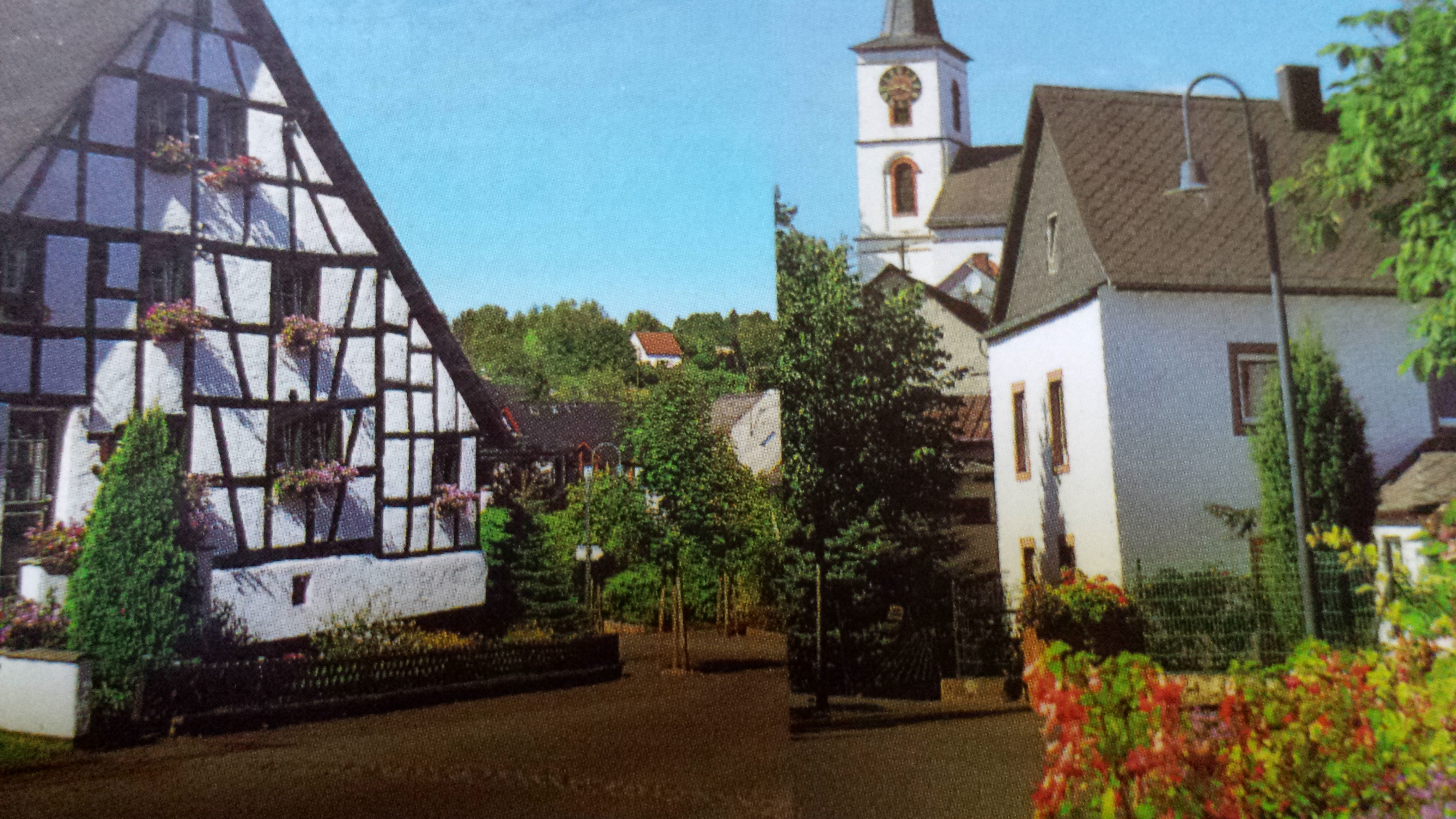
Pictured below is the village of Schalkenmehren.

2014-08-25 16.27.54

On a cold damp morning, in the year of 1813, church bells rang in the village of Schalkenmehren. The Uelmen family were burying Mathias Uelmen.  Left behind was his widow, Sophia Schimplin and five children ranging in ages from 25-4.

At Sophia’s side was my great-great grandfather, Johann Adam, a little boy of 7. The family followed four men carrying the body of Mathias. At the graveyard the bearers gently placed the covered body into a grave beside, Johann Adam’s older brother, Jacob, who had died three years earlier at the age of 15.

A year later Johann Adam would stand in the same graveyard and say good-bye to his mother..

Who took on the task of caring for  Johann Adam, his 5 year old brother and 10 year old sister?  Most likely a relative, perhaps his maternal grandmother, an aunt, uncle or even his eldest sister who had married several months before.  The other two siblings were probably old enough to fend for themselves.Life in Johann’s early years would have been tough. For many years there had been a series of poor harvests. The area wasn’t of a big interest to the warring countries on either side but troops their troops needing to winter somewhere often flooded  in, increasing the  burden of the area’s  limited resources.  Furthermore, the lack of roads prevented the trade of goods with bigger cities and the development of industry that might have provided jobs. Compounding these problems was the practice of willing the family property to all of a couple’s children.  Parcels of land were divided and scattered making it difficult to have profitable farms.

In 1816, 2 years following Johann’s mother’s death, the area endured what became known as the “year without a summer.” Volcanic dust caused by  the  volcano, Tambara lowered temperatures all over Western Europe and North America and created the worst famine of the 19th century.  Food prices soared.  Adding to the famine, troops returning home from the recently ended Napoleonic war, confiscated food to pay for the war. Villagers had to give as much as half of their crops as taxes not to mention the usual tithes, fees and rents.

Somehow Johann Adam managed to survive and grow to adulthood.  He probably attended school until he was 13. After that he would have spent many years working and or learning a trade. It was  common in this region to postpone marriage for years due to the problems mentioned above,

He may have lived and worked in the various villages that dot the area until he had made enough money to settle in the village of Strohn and marry Margaretha Lehnertz of Eckfeld in 1839. (Daughter of Peter Lehnetrz and Maria Barbara Schimtz.)  Johann Adam Uelmen was 33 and she  27.

( note:  Margaretha’s mother was born in Strohn and while she married Johan Adam in Eckfeld  both of her parents died in Strohn.  Her mother in 1824 when Margaretha was only 11, her father in 1845.  It is possible they lived in Strohn because of property inherited from Margaretha’s mother’s side of the family.) 

Johann Adam and Margaretha had 6 children over the next 12 years – Katherina b. 1840, John Adam b. 1842, John Joseph b.1843, Nicholas b. 1845, Anna Gertrude b. 1847 and Peter b. 1852.  All but John Joseph would lived to adult hood.

Below is a photo of Strohn today.  It looks like a nice  quiet place to live or visit doesn’t it?

So why did the family leave?2014-08-12 16.57.02

By 1838 the land in this area had had been divided among heirs for so many generations that the farms had become too small to be viable.  In addition the villages of  this region had changed from growing crops like spelt and oats to a reliance on root vegetables, primarily potato. Ireland was not the only place to suffer from potato blight. Also changes in industry and the lack of roads made it difficult to make a living in other ways.

By the time of Johann Adam Uelmen’s marriage chain migration from this area had already begun.  As family and friends moved away they sent back letters and information encouraging other to come and join them.

In July of 1844, five years after Johann Adam’s marriage, his older brother, Mathias  emigrated to to Wisconsin.  In 1851 Margaretha ‘s  brother went followed by another brother of Johann’s in 1852.  Before long they they were followed by two more sisters.  By1857, the year Johann Adam and his wife left, the couple had  5 siblings living in WI.  With little hope for their children’s future is it any wonder they chose to join their family and friends in WI?

Johann Adam’s family,  including my great-grandfather Peter- age 5,  arrived in N.Y.  on July 2, 1857 aboard the ship “Yorktown” from London.  Their voyage would have been similar to the one the Meyer family took.  Once in New York they would would have started west by way of the Albany and Buffalo Canals. Then by boat through the great Lakes to somewhere near Milwaukee or Sheboygan. Perhaps they were met by family, perhaps not.  Either way, they then made their way by foot or wagon to St. Michael’s, WA county, WI.

Joanne Adam was said to have brought grape plants for making wine with him. The climate of WI did not suit them and they died. Johann Adam too,  died less than 3 years later in April of 1860. He is supposedly buried in the cemetery of St. Michaels’ catholic church. No grave stone now remains. A flood in the early 1920’s may have destroyed it.

Why did so many people of the Vulkaneifel region area of Germany  choose to come come to WI instead of elsewhere?  I can’t say for sure but I do know the state of WI took an active role in encouraging immigrants to choose their state. Those coming from the Vulkanefiel region mostly settled in area of Fond Du Lac County, WI or Lorraine, Ohio.  In some cases entire villages disbanded and went to America.  By the time this chain migration  ended over half the population of the area had left.  Only Ireland’s mass emigration during the potato famine was larger.

My next posting will be one of the sort of letters that likely influenced the Uelmen family to abandon a homeland they’d loved for generations for a new place called America.